
Adjunctive Cancer Care: Repurposed Drugs & Metabolic Therapy
Repurposed drugs. Metabolic interventions. Integrative therapies. A research-backed approach to cancer care — alongside or independent of conventional treatment.
%
Improvement in 5-year cancer survival rates over the last 25 years
Months of improvement in overall survival from new cancer therapies over the last 15 years
About Adjunctive Cancer Care

A 25 year set of data from the U.S. indicated that 5-year cancer survival rates have only increased by 5% (63% to 68%). This is in spite of the fact that many billions have been poured into cancer research. For all these billions spent, the improvement in overall survival by new cancer therapies is just 2.4 months over the last 15 years (Ladanie et al). Over the last 30 years, another study reports an improvement of 3.4 months (Del Paggio et al).
The above statistics demonstrate an urgent need to identify more effective therapies, that come at less expense and have lower toxicity profiles than what traditional care is offering. To address this need, our practice delivers adjunctive cancer care to any cancer patient that wants to seek out this type of care. Our care program uses repurposed pharmaceutical drugs and nutraceutical supplements, as well as metabolic/lifestyle interventions to address multiple different cancer pathways, as well as cancer stem cells
Unlike traditional care, our program sets to target different root cause of cancer – such as metabolic dysfunction – based upon the research of Otto Warburg, Thomas Seyfriend, and many more. While chemo and radiation do not target Cancer Stem Cells, our therapies do. While chemo and radiation are cytotoxic and indiscriminate in the cells they target, our therapies support healthy cells while targeting cancerous ones.
On this page, you will find more information about our care model and costs, our treatment approaches, patient experiences via testimonials, answers to frequently asked questions, and additional resources.

Provider Appointments
Our care model is built to support patients with a high level of 1:1 care. Patients have frequent visits with providers as they begin adjunctive cancer care with our practice. In the first 4 months, patients are seen 3 times. Their initial visit is an hour long, and the two followups are 30 minutes each. This initial phase of care is designed to help patients initiate a multi-pronged approach that involves lifestyle changes, and a new medication/supplement schedule. After the initial phase of care, there are continued care options
See a list of our providers that provide Adjunctive Cancer Care
Nursing Support
We use a staff of Registered Nurses, not Nursing Assistants, to maintain a high level of quality care throughout the patient experience. Our RNs provide frequent check-ins with patients in-between appointments. In the initial 4 month program, nurses provide proactive phone call check-ins every other week to help patients undergoing repurposed drug and metabolic cancer care manage adjust to care plans, answer questions, titrate dosing, etc… The goal is to ensure patient adherence to a plan of care, help manage symptoms, and address patient questions. Patients can also proactively call the nursing line at any time if their needs require it. Our patient portal also allows for secure messaging. Nursing support goes on for the duration of patient treatment.
Learn more about our Nursing Staff
Evidence-Based Treatment
Evidence-based medicine is a systematic approach to patient care that that combines clinical expertise, research evidence, and patient values. This is the approach we took with our Long Haul Covid and Post-Vaccine Syndrome patients, that we are now applying to those seeking metabolic and repurposed drug cancer care. Our continued commitment to research, combined with our clinical observations, will continue to help provide a better path forward for those suffering from cancer.
Pricing
The initial 4 months of care, which includes 3 visits with one of our skilled clinicians and support from the RN staff, is $3,900. The initial visit is a comprehensive hour long appointment. The two followups are 30 minutes each. The RN Staff support includes proactive and coordinated followup from a specialized and dedicated Registered Nursing team. They provide proactive followup calls every other week during the 4 month program. In addition to proactive calls, there is also business hour phone line accessibility to your dedicated nursing staff as you need. You also can send the nursing staff 7 messages/week.
Become A Patient - No Matter Where You Are Located
Receive proactive adjunctive cancer treatment with metabolic interventions and repurposed drugs in all 50 states. To become a patient of Leading Edge Clinic, you must first register. Registration does not require a monetary commitment, and allows us to reach out to interested patients who may have questions about our care model, treatment modalities, etc…
Operating under the legal framework of the First Nations Medical Board allows us to see patients in all 50 states. More information about the First Nations Medical Board can be found under the “General Practice” section of our FAQ page
Frequently Asked Questions
Can I use adjunctive cancer care alongside chemotherapy, radiation, or immunotherapy?
Quick Answer: Yes — and in many cases, our repurposed drug protocols actively enhance the effectiveness of conventional treatments like chemotherapy and radiation while supporting healthy cells throughout the process.
The word “adjunctive” means added to something else. Our program is specifically designed to work alongside whatever conventional treatment path you and your oncologist choose.
How our protocols support conventional treatment:
- Repurposed drugs can help overcome multi-drug resistance — a common reason chemotherapy loses effectiveness over time
- Metabolic interventions reduce the environment in which cancer cells thrive, amplifying the impact of conventional therapies
- Nutraceutical supplements support immune function and cellular health throughout treatment
- Our protocols target Cancer Stem Cells — which chemotherapy and radiation largely do not
We monitor continuously for interactions:
As your oncologist adjusts your conventional treatment, our team reviews your full protocol for potential drug and supplement interactions. You are never managing two treatment paths alone.
For a comprehensive review of the synergistic effects between repurposed drug protocols and conventional cancer treatment, Dr. Paul Marik’s cancer care research provides an extensive evidence base.
Do I have to continue conventional cancer treatment to work with you?
Quick Answer: No. You decide the role conventional treatment plays in your care. We work with patients across the full spectrum — from those combining our protocols with active chemotherapy, to those who have made an informed decision to pursue repurposed drug and metabolic approaches exclusively.
We treat patients in several situations:
Currently in conventional treatment:
- Adding our protocols alongside active chemotherapy, radiation, or immunotherapy
- Using repurposed drugs to enhance conventional treatment outcomes
- Managing side effects and supporting overall resilience
Conventional treatment complete:
- Ongoing adjunctive protocols post-remission
- Metabolic maintenance to prevent recurrence
- Monitoring and continued support
Choosing not to pursue conventional treatment:
- Patients who have made an informed, considered decision
- Patients who have exhausted conventional options
- Patients seeking a purely metabolic and repurposed drug approach
Our position:
We respect patient autonomy completely. We will provide you with the most thorough information available about all options — including the evidence that many of our protocols enhance conventional treatment outcomes — and support whatever path you choose.
We highly recommend thorough research and, where possible, consultation with an integrative-minded provider before making this decision.
What does adjunctive cancer treatment involve?
Quick Answer: Our adjunctive cancer care program targets cancer through multiple simultaneous pathways — starving cancer cells of their fuel, targeting Cancer Stem Cells, disrupting cancer cell signaling, and inducing cancer cell death — using repurposed pharmaceutical drugs, nutraceutical supplements, and metabolic interventions.
The Treatment Philosophy:
Conventional chemotherapy and radiation work by broadly attacking rapidly dividing cells. Our approach is different in two fundamental ways:
- We target root causes: The metabolic dysfunction that creates an environment where cancer can arise and thrive
- We target Cancer Stem Cells: The cells responsible for cancer recurrence that conventional therapies largely miss
What Treatment Addresses:
Metabolic Interventions:
- Eliminating the fuel sources cancer cells depend on
- Restoring healthy cellular energy production (ATP)
- Creating an internal environment hostile to cancer proliferation
- Dietary and lifestyle protocols that support treatment
Repurposed Pharmaceutical Drugs:
- Medications originally developed for other conditions that demonstrate significant anti-cancer properties in research
- Targeting specific cancer cell signaling pathways
- Inducing apoptosis (programmed cancer cell death)
- Inhibiting angiogenesis (the blood supply that feeds tumors)
- Targeting Cancer Stem Cells
- Overcoming multi-drug resistance
Nutraceutical Supplements:
- Evidence-based compounds with anti-cancer mechanisms
- Immune system support throughout treatment
- Cellular protection during conventional treatment
- Compounds that enhance the effectiveness of other interventions
What Makes This Different:
| Conventional Treatment | Adjunctive Protocol | |
|---|---|---|
| Primary target | Dividing cells broadly | Cancer stem cells + root cause |
| Cell selectivity | Cytotoxic (affects healthy cells) | Supports healthy, targets cancerous |
| Metabolic focus | None | Central to approach |
| Cancer stem cells | Largely missed | Directly targeted |
| Combination | Standard protocols | Personalized multi-pathway |
Our program draws primarily from Dr. Paul Marik’s Tier 1 and Tier 2 cancer care recommendations, supplemented by our own clinical observations from treating cancer patients directly. The foundations of care are largely the same, with updates made as new research and clinical observations guide us towards better cancer care outcomes.
Does adjunctive cancer care replace my doctor or specialist?
Quick Answer: No — and we want to be direct about this. We are experienced Clinicians applying the best available research to give cancer patients additional evidence-based therapeutic options. We do not deliver standard oncological care and do not replace the role of your oncology team.
What we are:
- Physicians and advanced practice providers specializing in repurposed drug protocols, metabolic interventions, and integrative care
- Partners to your existing medical team
- Providers who communicate openly with your other doctors
- Specialists in what conventional medicine is not currently offering
What we are not:
- Oncologists delivering chemotherapy or radiation
- A replacement for specialist cancer care
- Providers who discourage you from working with other doctors
Our recommendation: Where possible, we encourage finding a provider with an open mind toward integrative approaches. Increasingly, forward-thinking physicians are willing to work collaboratively with our protocols — particularly as the evidence base for repurposed drug cancer treatment continues to grow.
What we bring to your care team:
We contribute something your oncologist likely isn’t providing — a metabolic and repurposed drug approach informed by research, such as that of Dr. Paul Marik, and our direct clinical experience treating cancer patients. These are not competing approaches. They are complementary ones.
How do I talk to my doctor about repurposed drug cancer protocols?
Quick Answer: Dr. Paul Marik’s cancer care research provides a comprehensive, rigorously cited evidence base that you can share directly with your medical team — covering the pharmacological mechanisms, clinical studies, and safety profiles for each intervention in our protocols.
Why this conversation can be difficult:
We recognize that even with compelling evidence, some providers will be skeptical of repurposed drug approaches. This is not always about the quality of the evidence — it can reflect institutional culture, training, and the inherent conservatism of conventional medical practice.
Practical steps for the conversation:
1. Come prepared with research: Dr. Marik’s cancer care book is one of the most comprehensive compilations of repurposed drug cancer research available. It provides the citations your doctor needs to evaluate the science independently.
2. Frame it as complementary, not competitive: Most providers respond better when repurposed protocols are presented as additions to conventional care rather than replacements. Our research supports this framing — many repurposed drugs enhance conventional treatment outcomes.
3. Ask specific questions: Rather than asking “can I do this instead of chemo,” try “I’d like to understand if any of these interventions conflict with my current treatment plan.”
4. Seek an integrative-minded provider if needed: If your current team is firmly closed to these conversations, finding a provider with an integrative philosophy may be the most productive path forward.
Our team can help: We’ve had these conversations hundreds of times and can help you prepare for discussions with your medical team. This is part of what we do.
How long does adjunctive cancer treatment last?
Quick Answer: Most patients remain on some level of repurposed drug protocol for a minimum of one year — including after remission. This is because the conditions that allowed cancer to develop are ongoing and require sustained management.
Why treatment may continue after remission:
This is one of the most important concepts in metabolic and repurposed drug cancer care, and one that distinguishes our approach from conventional treatment.
Conventional medicine largely stops active treatment at remission. Our approach recognizes that:
- The metabolic dysfunction underlying cancer doesn’t disappear with remission
- Cancer stem cells can persist and reactivate in favorable metabolic environments
- The conditions that allowed cancer to arise can be recreated if metabolic management stops
- Ongoing low-level protocols maintain the hostile environment for cancer recurrence
Treatment phases:
Active Treatment Phase:
- Full repurposed drug protocol
- Intensive metabolic interventions
- Dietary and lifestyle changes
- Frequent monitoring and adjustment
Remission Maintenance Phase:
- Continued metabolic management
- Reduced but ongoing repurposed drug protocols
- Lifestyle practices that sustain a cancer-hostile environment
- Regular monitoring
Long-Term Prevention:
- Metabolic health as ongoing practice
- Minimal maintenance protocols
- Environmental toxin awareness and reduction
- Participation in our 5-year observational study
The core principle: Cancer is not just a tumor. It is a metabolic disease that develops in a dysfunctional internal environment. Lasting recovery requires addressing that environment — not just the tumor itself.
Is adjunctive cancer care a cure for cancer?
Quick Answer: We do not offer or claim a cure for cancer. What we offer is a rigorous, research-backed approach that addresses the metabolic root causes of cancer — creating conditions where cancer struggles to survive and grow, and where the body’s own systems are supported in fighting it.
Why “cure” isn’t the right framework:
This isn’t a legal disclaimer — it reflects a genuine understanding of what cancer is.
Cancer is not simply a tumor that can be removed and forgotten. It is the result of metabolic dysfunction — a progressive condition in which the body’s cellular environment has become hospitable to cancer development.
This means:
- Removing or killing the tumor doesn’t resolve the environment that produced it
- “Cure” implies a one-time intervention, when cancer requires ongoing metabolic management
- Remission is a milestone, not an endpoint
What we have seen in our patients:
We have treated patients with advanced-stage cancers — including Stage 4 metastatic lung cancer and Stage 4 pancreatic cancer — who have experienced meaningful improvements in disease markers, quality of life, and survival outcomes.
We document these outcomes through our formal observational study, tracking patients through 5 years. This ongoing data collection and clinical observation is how we continue to refine our protocols and understand who responds to which interventions.
What we can honestly say:
- Repurposed drug protocols have demonstrated anti-cancer mechanisms in published research
- Metabolic and repurposed drug interventions create conditions hostile to cancer cell survival
- Our clinical experience shows meaningful outcomes across cancer types and stages
- We pursue the best available evidence relentlessly and adjust our protocols as it evolves
We don’t promise outcomes we can’t guarantee. We promise the most thorough, evidence-informed, personalized approach to adjunctive cancer care available — and we stay with you for the duration.
What is the Leading Edge Clinic cancer observational study?
Quick Answer: Leading Edge Clinic is conducting one of the first formal long-term observational studies tracking patient outcomes under a repurposed drug and metabolic cancer care protocol — following patients for up to 5 years to understand what works, for whom, and why.
Why this study matters:
One of the most significant gaps in repurposed drug cancer research is the lack of long-term outcomes data from real patients receiving these protocols in clinical practice. Published studies exist for individual drugs, but comprehensive outcome tracking across a full metabolic and repurposed drug protocol is rare.
Our observational study is designed to fill that gap.
What the study involves:
- No placebo: This is observational — every patient receives active treatment
- No treatment mandates: Patients are not required to follow any specific aspect of their protocol to participate
- No impact on care: Choosing not to participate has zero effect on your treatment
- Long-term tracking: Data collected through a 5 year period
- Outcome focus: Understanding which patients respond to which interventions, and why
Who conducts the data collection:
The Rebuild Medicine observational study data collection team manages all data gathering at each milestone. If a patient is lost to follow-up at any point, the team follows up by telephone to capture updated health status.
Why participate:
Beyond your own care, participation contributes to something larger — building the evidence base that could make repurposed drug cancer protocols available to far more patients in the future.
Every patient who participates is contributing to the future of cancer care.
Additional Adjunctive Cancer Care Resources
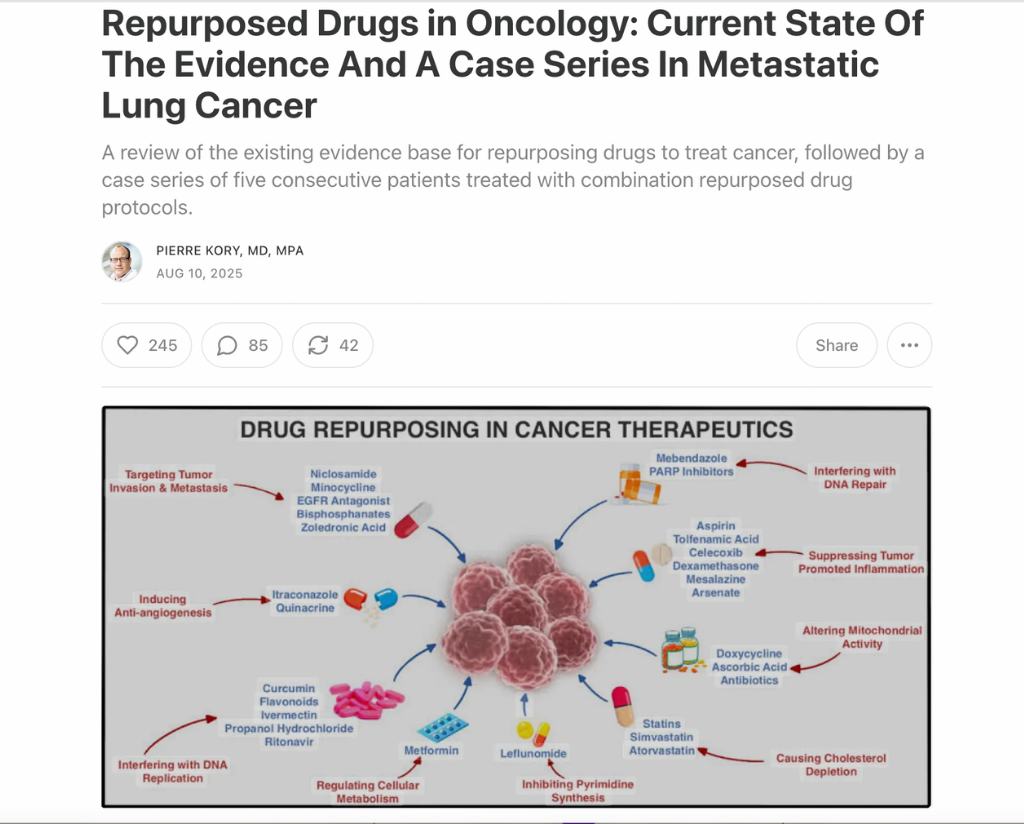
Case Series: Metastatic Lung Cancer Patients
Dr. Kory writes about five advanced stage Metatatic Lung Cancer patients receiving adjunctive cancer care

Dr. Kory Dispels Somatic Mutation Theory
A dismantling of the prevailing theory that has improperly driven cancer research for decades, and set back patient outcomes

Dr. Kory Shows Validation for Metabolic Theory
A substantiation of the root cause theory that informs our research and treatment of cancer, focused on patient outcomes

Pancreatic Cancer Case Study
Debbie Moyer, AGPCNP-BC, discusses the treatment decisions made for a Stage 4 Metastatic Pancreatic Cancer patient
