Once upon a time there were classes in art, music and gym from Kindergarten through senior year in high school. Budget cuts, oversized classes and teaching to standardized test scores rather than comprehension and life skills have all taken an axe to these lifelines.
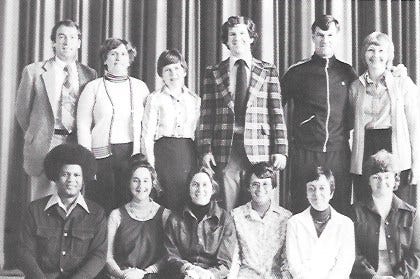
Webster Hill Elementary “Specials”, Mr Greaney back row, second from right
Mr Greaney was my gym teacher for those seven years of elementary school. He was a tall man with a deep voice and most of the year he wore a navy blue warmup suit, with white racing stripes. No matter your age or size, birthdays meant that you ended up over his knee with the class counting out loud as he gave you a gentle number of swats on your bottom equivalent to your age— and one for good measure! Jesus, Joseph and Mary, it’s like I’m telling a science fiction story for the resemblance between those moments and the politically correct, touch-phobic, probiety of the present.
Nobody messed with Mr Greaney. I don’t care if you thought you were a tough guy from the slums of Hartford, you were no match for him, and you knew it. Period.
Junior high school was a different scene, but our teacher was another physically fit and generally cool cat name Mr Steiner. He had black wavy hair and a mustache. He was perpetually relaxed, and had really good attention, meaning that when he was talking to you, you had him.
How many of us were vulnerable to the attention of adults when we were kids? I had been missing my dad since my parents divorced. My stepfather and I were locked in a battle of wills, and I ached for a father figure in my life who could help me find my way and love me with all of my faults. This is rich territory for pedophiles, and they were there in the shadows for sure. A narrow escape from one such predator is a topic for another day. It was both my good fortune, and painful dilemna, that Mr Steiner was a kind man who cared about his students in general, and me in particular.
Coach called the boys Chief, or Rocky, or some other name which he probably called hundreds, if not thousands, of other boys during his career. He called me, and only me, Moose. I chose to hear his designation as a sign of his respect and affection for me.
My best friend in junior high and freshman year of high school was Bill. He was a good student: big, strong, and willful. We both lived in households where alcohol influenced our family dynamics; still overflowing in mine, chicken scratching to maintain sobriety in his. In our circle of friends were other boys like Bob and Kevin who were physically strong and intellectually gifted. When Billy decided to join Bob and Kevin, on the freshman wrestling team, he persuaded me to sign up too. Mr Steiner just happened to be the high school wrestling coach.
The first weeks of wrestling practice are still pretty clear in my mind. The sheer physicality of it, the burning lungs, weary muscles, omipresent smell of adolescent sweat, and getting pounded on the mat time after time after time. As I’ve written before, I have plenty of experience with losing, but this took it to another level. After each practic, I remember the dim light of the locker room and the smell of Mennen SpeedStick. I would catch the late bus with just a few others, headed home in the dark, with a quarter mile walk home at the end of the bus ride. Once home I would scarf down dinner and then hit the books, every single weeknight.
About three or four weeks in, I decided I’d had enough. I was old enough to know what hard was, and this was beyond hard. It was like when you’re a little kid learning to walk and you faceplant on the sidewalk, except it keeps happening over and over. Sitting in Mr Steiner’s office and telling him that I was quitting was painful. I yearned for his approval. He wasn’t unkind, but in a way that made it harder. He said “Moose, I think you were doing well, that you could be good, if you stuck with it. I’m disappointed, and just afraid that quitting the team will become a pattern in your life. We learn persistence early.” Oooof!
Right in the solar plexus.
A few months later I was moving in with my adoptive paternal grandparents. I began to have chest pain and shortness of breath. It felt like I had an elephant sitting on my chest. Years later, my dad confided to me that my Pop pop had called him wondering if I was reacting to the stress of the recent upheaval in my life, and perhaps I was a bit of a hypochondriac. We went to my new pediatrician, he referred me to a sharp pediatric cardiologist, who quickly diagnosed me with idiopathic subaortic stenosis, which later became known as hypertrophic cardiomyopathy or HCM. He quickly arranged for an evaluation at the National Institutes of Health (NIH) in Bethesda, MD, the closest research center with significant experience in surgical intervention for HCM. This became the first of many trips Pop pop and I made together from our village of Parkerford, PA to the vast campus of the NIH. After a cardiac catheterization, surgery was recommended, and a week later I was on the operating table.
HCM is the number one cause of sudden cardiac death in young athletes, or at least before the pandemic it was. Over the years I can count three families connected to mine who have lost a son or daughter to undiagnosed HCM, all in their early 20s. Even in my teens, I quickly connected the dots, and understood that if I hadn’t gone against my aching need for the approval of Mr Steiner, I probably would have died on the wrestling mat. It really was too hard, and somehow I knew it.
RECENT PAST
Because I wasn’t able to participate in organized sports, or even regular gym class after my surgery, I was assigned to the Breakfast Club version of gym in high school with Mr Ronald Pearson, also known as Mr P. He was the Athletic Trainer for all of the sports teams, and had a group of students who volunteered as assistants. After a stint as a statistician for our champion football team, I became an assistant athletic trainer, and enjoyed traveling not only with the football team, but also boy’s basketball and the girl’s lacrosse team.
When I trundled off to Susquehanna University to study business economics, I had a work-study job as an athletic trainer before classes had even started. It was skilled and satisfying work with all the athletes, traveling with the football, men’s basketball, and women’s field hockey teams. Oddly, it had nothing to do with my chosen field of study, and everything to do with what would become my calling a decade later.
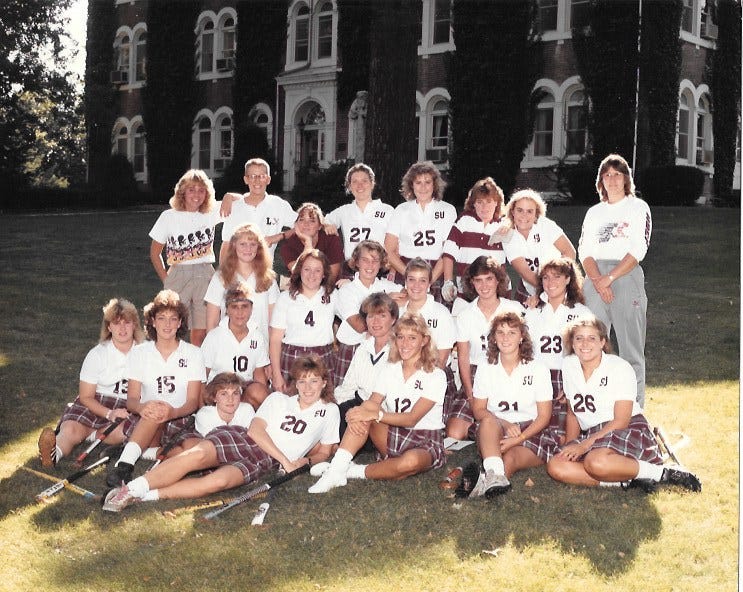
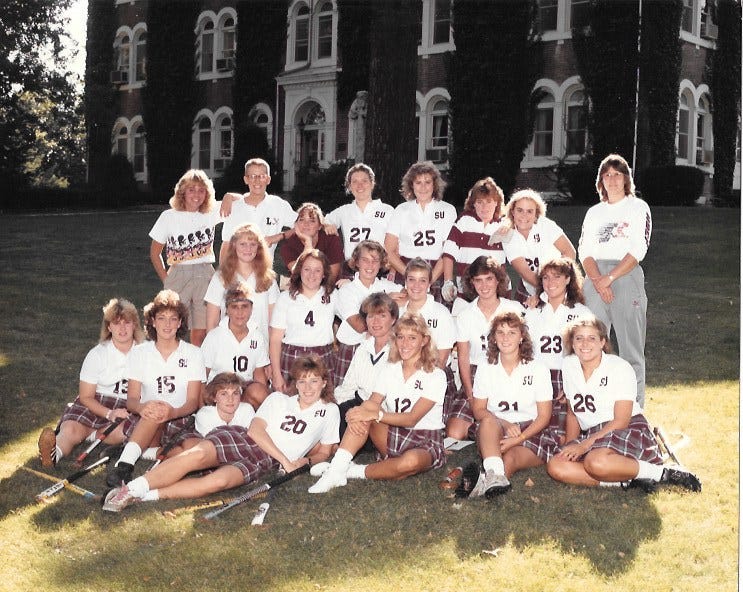
Susuehanna University Women’s Field Hockey 1987-1988 (Connie is wearing a V-neck sweater, seated next to #12)
Connie Delbaugh was the golden haired beauty who coached field hockey, and was romantically involved with Don Harnum, the handsome Director of Athletics and men’s basketball coach. I loved working with the field hockey team, and would hang with them after practice and games. They were some seriously tough and sexy women, a few of them heavy drinkers who could get pretty rough. Nancy, #27 in the photo, was the recipient of my daily treatment for shin splints in the training room. We became close friends, and after a while longer, romantically involved.
Coach Delbaugh was very kind to me and made me feel welcome and appreciated for my efforts. This is a small but poignant example. Once we arrived early for an away game and the gate was locked, with nobody around. I volunteered to climb over the fence and unlock it from inside, managing to tear my pants in the process. She took them home and repaired them by hand. Good golly.
PRESENT
In the first and second case studies I have presented at the last two FLCCC Alliance conferences, and the case study in my substack last week, pacing has been the Achilles heel of each patient. It isn’t for nothing that Dr Walskog of REACT-19 presents the number one consensus recommendation of vaccine-injured as pacing. Not only is that true, but also that Physical Therapy is more likely to hurt patients with post-acute sequelae of COVID (PASC) and vaccine injury than to help them.
It has been with trepidation that I have enouraged some of my patients to explore Live02 as a tool to heal their enodthelium, decrease the pathological basis of their microclotting, and get back to a higher level of physical activity. The pre-pandemic use of Live02 incorporated extended periods of hypoxia (low oxygen) to cause vasodilation before then flooding the person with 100% oxygen while engaging in aerobic activity.
Our first patient to try this went to a studio in Baltimore, MD, felt great while doing Live02 with periods of hypoxia and increased resistance, for twenty minutes right out of the gate. Then he was down mentally, emotionally and physically for at least a week. The therapy harmed him.
Trying to learn from this initial experience, I counseled patients to avoid the hypoxic setting. A second patient went to a Live02 trainer, was run through a training session with periods of increased resistance and no hypoxia, felt okay during the session, and then experienced a dramatic decline in his status within tweny four hours. He developed dyspnea, chest pain, near syncope, and severe POTS symptoms, with a sharp escalation in his tinnitus. The effect was to set him back months in his clinical progress.
Still gathering information and trying to avoid any harm to other patients, I wrote out a short, very simple and firmly worded plan of care for patients who wished to try Live02. No hypoxia for at least two weeks, AND no increase in resistance. 100% 02. Slowly increase the time period of Live02 from three minutes (yes, only three minutes) the first session, to five the second, seven the third, nine the fourth, etc. Two patients improvised and incorporated near infrared sauna (NIR) for about forty five minutes prior to their Live02 sessions, took things slowly, avoided hypoxia and resistance, and have done very, very well.
The successes and lessons learned were communicated to other patients. Then last week I had a report from a patient who went to two sessions. Despite my instructions, the patient was assured by the trainer that he had helped many people with PASC and vaccine injury “go from bedbound to running marathons.” He put my patient on a treadmill with resistance, and ran him for 1.5 miles or > 20 minutes on the first day. The patient felt good during the sessions, but experienced an increase in his internal vibrations, dyspnea, and fatigue over the two days following each episode, coming back up to baseline.
I wasn’t very happy. I think that what is more dangerous than a trainer or practitioner who doesn’t know what he/she is doing, is one who is confident that he/she knows what he/she is doing, but is actively harming patients. The simplest way I can explain this is that pre-pandemic expertise expired around November 2019, and our bodies behave differently now, posing many challenges and mysteries to the individuals and practitioners trying to help them recover. We have a study in which muscle biopsies of both control and PASC patients pre- and post-exertion showed actual muscle necrosis and amyloid protein deposits in the tissue of the PASC patients. Going too far, too fast, is going to harm people.
My plan is to write a letter to the folks who manufacture and sell the Live02 setups, but they don’t supervise or control the people who purchase their equipment. I’m going to share this letter with my patients, and ask them to present it to the trainer they encounter when they book a Live02 session. I have low expectations that the trainers will pay it any heed. In the meantime, please beware of the Live02 trainers who claim to be helping hundreds of patients return to their marathon running capacties. That isn’t what I’ve seen in practice, and I think we need to make adaptations for the bodies we live in today.
P.S. Before I graduated from Susquehanna University, one of my closest friends presented me with a mix tape titled “Favorite songs for the men in my life.” It included Ode to a Gym Teacher by Meg Christian.
I’ve always been small. If you believe that adversity builds character, then I’m a capital C Character, as I’ve encountered my share of bullies. But sometimes they bit off more than they could chew.
This story can be told today because we have exceeded the statute of limitations, and ultimately nobody was hurt. If it happened today, I probably would have gone straight to the juvenile detention center and never made it to college. Or the bully’s parents would have sued mine and I’d have been expelled from school. It was one of those forks in the road of life and a choice had to be made.
I think his name was Brandon. He was dumber than a box of rocks, and got it into his mind that he was going to make me his punching bag. Each day after school he would be on my tail as soon as the final bell rang. In those days we could walk or bike to school. Uphill, through freezing sleet, in subzero Connecticut temperatures. There were no buses for us local kids. The buses were for the kids being trucked in from Hartford as part of court-ordered racial desegregation.
Just like in a bad movie (think Bad Santa) there would be a flock of boys behind Brandon as he towered over me; belittling me, shoving me, which usually ended up with me landing hard on the sidewalk. I didn’t think to ask for help. Both of my parents worked, and I didn’t see trustworthy allies among the teachers or school staff who only wished I took more Ritalin.
But I had an idea and a plan! In the junk drawer at home there was this knife. It wasn’t a switchblade exactly, but the knife retracted, a cheap plastic and metal freebee from some hardware store. The plan was to skip the sidewalk and instead ride my bike to school, and when the bell let out, fly out of there as fast as I could pedal. This part worked. But instead of going home though, I biked to Brandon’s house, tossed my bike in some bushes, and crouched under the branches of an evergreen tree. A little while later, Brandon showed up—alone. Just as he passed by I leapt out and jumped him. It may have all been very comical to an outsider, but it was serious as death to me.
We fell over together, and rolled around for a bit. Mind you, I was half his size, but I had the element of surprise in my favor. While we were still on the ground, I pulled out my knife, and slid the blade out for dramatic effect. I held it under his chin and basically said, “If you every mess with me again, I’m going to cut off your family jewels and jam them down your throat. Understand?” His eyes and very subtle nod indicated that yes, indeed, he understood.
End of story. Brandon never bothered me again. I never pulled a knife on anyone again. In fact, none of those boys ever seriously bothered me for the remainder of elementary school.
RECENT PAST
When I first started working at SUNY Upstate in the Emergency Department, I laid low and said nothing about my recent unionizing efforts at my previous place of employment. At Cayuga Medical Center in Ithaca, NY, I was one of two nurses who lead a failed attempt to unionize, and was one of the first to go. Somehow the schedule no longer had room on it for me. SUNY is unionized from top to bottom. The managers and professors are affiliated with UUP, nurses with the Public Employees Federation (PEF), and everyone is with CSEA.
It was three years into my time at SUNY Upstate that I was pulled into the fray by Llamara Padro Milano. I’m a sucker for a courageous woman struggling against the odds. She was the besieged Council President for more than 2,000 Registered Nurses represented by PEF at SUNY Upstate. The Regional Representative had talked me up and persuaded me to go to the annual PEF convention, where I was introduced to Llamara.
Llamara is smart, courageous, hard-working and integrity-filled. It’s no wonder that she ran afoul of both the management at SUNY Upstate and the leadership of PEF. As Kermit the frog sings, “It ain’t easy being green.” Let’s distinguish between business unions and rank-and-file unions: business unions are mostly what we have in the US. You pay your dues and you get services from professional staff. They have paid organizers, and their idea of organizing is to get out the vote in elections for public office, or to coordinate a letter writing campaign. Generally speaking, the ideas and actions are top-down and these unions pose little threat to the seats of power. A rank-and-file union, which is what Llamara and I wanted to cultivate, will have workers who communicate with each other about the day-to-day conditions of their workplace and steps they can take to make it better. This typically involves overcoming their fear of being targeted and agreement to take action together. Historically, it is rank-and-file unions which have changed the course of history, when workers exercise their power, and management can sense that they are indeed outnumbered.
I would rather have a business union than no union, but if you are in a business union and you want to move it towards a rank-and-file union, you will get a quick and dirty lesson in who has power and what they will do protect it. I’m not even saying that the leadership of PEF was dishonest or power-hungry, although there were some stinkers embedded in the structure. It’s just a very different take on how things should go, and they don’t want meddlesome upstarts making their life complicated.
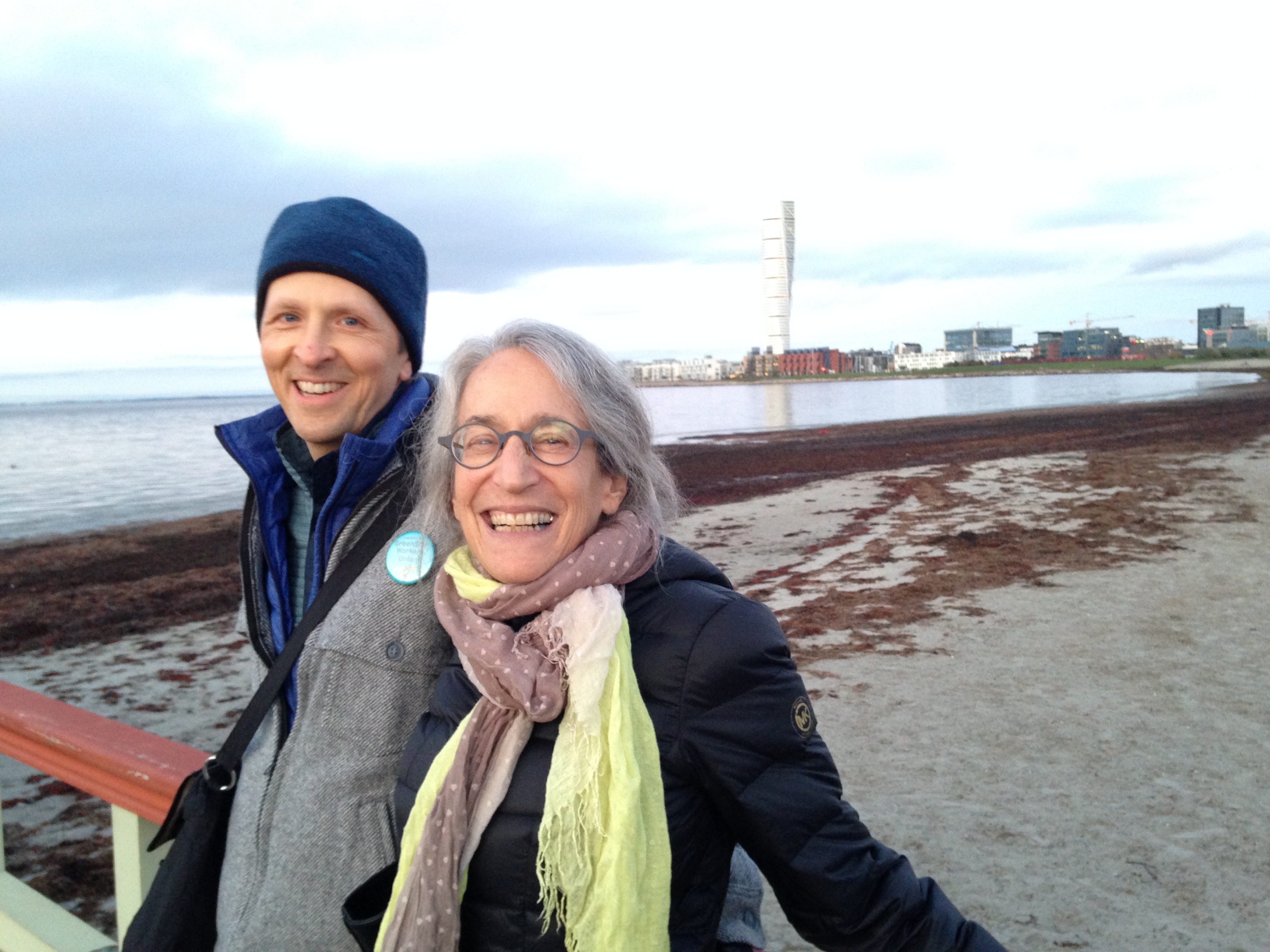
Me and Ellen in Malmo, Sweden
In February of 2019, I traveled to Sweden and Norway on a two week trip with my (rank-and-file) union mentor Ellen David Friedman. Ellen worked as a labor organizer in American education for forty years, and is an international leader for Labor Notes. She had been invited to present and conference with a wide range of unionists in both countries. We started our trip in Malmo, Sweden at a joint labor film festival and conference of SAC Syndikalisterna. Unlike other Swedish unions, SAC organizes people from all occupations and industries in one single federation, including the unemployed, students, and the retired.
Ellen strategizing with the Secretary and President of SAC
Just so you appreciate what a bunch of badasses the SAC are, during WWII it was the SAC that was publishing a newspaper openly criticizing the Nazis. Theoretically Sweden was neutral during the war, but Sweden traded considerable goods with Germany, particularly iron, iron products, ball bearings, and trucks. Lumber from Swedish forests was used to build barracks in the concentration camps. It was compliacted. Depending on whose narrative you read, many Swedes wanted SAC to shut its collective trap rather than provoke the Nazi bear.
I learned a lot on that trip. My illusions about the Swedish social experiment fell into disrepair as I learned that the Neoconservatives had persistently, successfully, undermined the social supports and collective bargaining agreements for which Sweden had become famous decades earlier. No stones were left unturned, in education, in healthcare, and in industry.
Meeting with the badasses of SDU
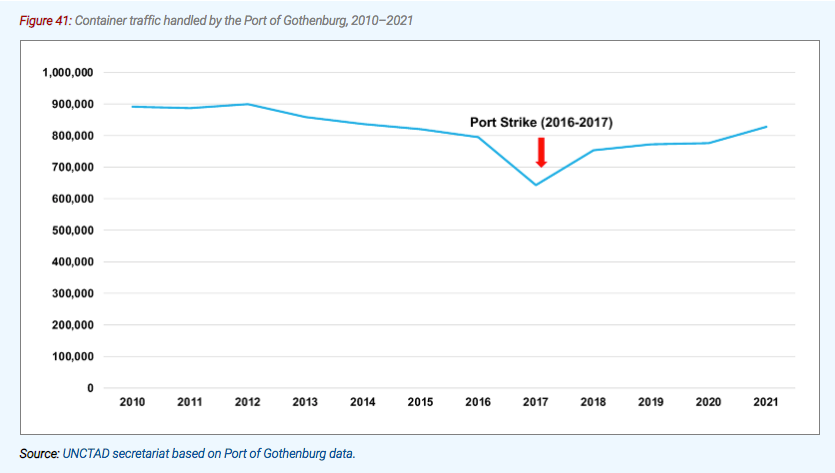
There was another group of badasses who we met during our trip. It was the proud women and men of the Swedish Dockworkers Union (SDU). When we conferenced, Ellen shared the powerful narrative of the American teachers who organized in West Virginia, Arizona and Oklahoma, as captured in Eric Blanc’s book Red State Revolt. Then the SDU leaders told us about shutting down the ports across Sweden and bringing industry to its knees in their 2016-2017.
I’ll tell you that reading the United Nations Resilient Maritime Logistics report on that strike makes me nauseous, but their visual tells the story. The globalist perspective of the UN leads to subversion of any and all efforts by people to excercise their collective power and engage in self-determination. The report encapsulates how global government (controlled by corporations) should decentralize transportation hubs and utilize a diverse and adjustable range of methods to transport goods. They make recommendations about how to go around these pesky workers fighting for their jobs, wages and safe working conditions. Legal protections and the right to strike which took more than a hundred years to establish, are subverted within a matter of years. And so the fight continues.
The 2016-2017 SDU strike had deep implications. As reported in Jacobin, 2.27.2019, nearly three years later, “The union is currently engaged in an existential struggle with employers from the entire sector. What began as an industrial dispute with APM Terminals at the Port of Gothenburg has become a national dispute that has included significant changes to the right to strike along the way, backed by the Social Democratic Party. In response to employer lockouts, the SDU has announced plans for indefinite strike action. The future of independent, left-wing, rank-and-file trade unionism in Sweden hangs in the balance.”
I know folks got their ways of doing things Live where the low fruit hangs That’s how it is I can still see my mother’s hard-earned tears Across the years in my mind
What have I done? ‘Cept stand up for myself When I didn’t have anybody else What have I seen? Of an honest fight I’m just doing what I think is right
In our PASC and vaccine injury support group last night, I asked everyone to spend some time working on our relationship to fighting. Our families of origin profoundly shape how we fight, or don’t. How did this play out with our parents and siblings? Did we fight with words? Did we fight dirty? What was our experience in school, with friends, and with strangers?
The collective responses were very rich. It may have been one of the most meaningful meetings so far, in part because we have all come a long way in showing ourselves to each other. What was very clear is that almost every person in that group is a fighter. There are variations, which include fighting through resistance, silent (listening and observing) and deadly, guerilla, take-no-prisoners, the spitfire, and team fighter. We also agreed that we are all tired, and can notice that we don’t feel the level of fight in ourselves that we have embodied prior to being injured by the spike protein.
Regular readers may be scratching their heads and wondering how it is that I identify as a Quaker, yet am writing about fighting. This reminds me of one of my favorite Pop pop stories. We lived about an hour away from Lancaster, PA, Amish (and all-you-can-eat buffet) capital of the US as far as I’m concerned. So, an English (what the Amish call us non-Amish) tourist walked up to an Amishman who was purposefully avoiding eye contact and going about his business in town. Blocking the Amishman’s path, the aggressive and macho Englishman asks him, “Say old man, I heard that you Amish don’t fight. What kind of man are you?” The Amishman looks the Englishman up and down, weighs his response, and then says, “Brother, I may not hit thee, but I may hold thee most uncomforably.”
None of us in the support group consider ourselves fighters of aggression. Our collective life experience has been that someone, or some thing, brought the fight to us, not the other way around. Then we had a choice. In most cases we instinctively knew that to give in to a bully or injustice would invite more of the same, and so we stood our ground. We took our share of hits, and were ready to face the consequences of defending ourselves, because we have an internal moral compass which guides us regarding right and wrong, and the difference between the two.
A newer participant in our group made the profound observation that our burden is made heavier, because in effect we have a political malady. This reminds me of the politicization of AIDS in the late 1980s and the early 1990s. If you tell somebody that you have asthma for example, they would have a good idea what you meant, and that is was a real medical condition. Manifestation of injury following the COVID shots is extremely inconvenient to the safe and effective narrative which almost universally endorsed by our healthcare system, and the powerful economic interests it serves. The McSick system is weighted towards marginalizing us with diagnoses of functional neurological or generalized anxiety disorder, because the rubric of its diagnosis codes and tests can’t identiify or explain the pathology we are carrying.
One among us is a veteran of multiple combat tours in the military. You haven’t seen nuthin’ till you witness a plucky twenty-something country girl from Montana giving what-for and a motivational pep talk to someone who used to command 800 men. It brings tears to my eyes. She was fighting for him, when he wasn’t clear about how to fight for himself, feeling indecisive, when he has always been a person of strategic decisions of tremdous consequence.
Which raises the questions…who or what are we fighting against? What are we fighting for? Who are we fighting alongside? And how are we to fight?
As individuals harmed by the virus and the shots, trying to heal, we have been forced to look squarely at the evil before us. Only in this way have we been able to survive this long, against the odds. We are clear that none of this was an accident. This pandemic was planned for years; see the details of Event 201 hosted by Johns Hopkins University, and you will see the script for the last four years. Event 201 was a high-level pandemic exercise on October 18, 2019, in New York, NY. The bioweapons were waiting to be launched. The media response was and is coordinated. The evil geniuses are coming for us and our families. They won’t stop until they get what they want, a dramatically reduced global population. It’s unbelievable, yet true. This is not a drill. This is not 1944. This is 2024, and there is a global genocide in progress.
They aren’t hiding their agenda. It’s out in the open if a person is willing and able to see and listen. Although, it is stunning how many URLs for the World Economic Forum result in a message telling me that I can’t access that information with my server. Queue to minute sixteen of this interview with Yuval Noah Harari, one of the top advisors of the World Economic Forum, who asserts that we are moving towards a world where we will not need most of the people who are currently alive. I put the whole link here so that you know I’m not cherry-picking from the dystopian future he portends, in which AI reigns supreme, and humans are an afterthought.
As people with PASC and COVID vaccine injury, we carry these truths with us every day, in the face of the denial and disbelief of most people around us. This, despite the mounting numbers of injuries and deaths, the ever outwards expanding circle of turbo cancers which spring up suddenly and silence victims in mere weeks and months. We still have our autobiographical memory, curiosity, critical thinking and capacity to fight, even as the hippocampi of millions is rendered feeble and obedient by the lab-made spike protein.
The fight has been brought to us. It is on our doorsteps, in our homes, in our bedrooms. We are fighting for our health, our humaness, and for all of humanity. We are the bedraggled, overwhelmed and disabled, fighting side-by-side, back-to-back. We are slowly healing, sharing our stories, and gathering ourselves up. The forces of evil, in the characteristic hubris of the worst of archetypal villains, has woefully underestimated the persistence and badassedness of humankind.
My dad was a sales representative for a series of companies which make walk-in freezers. His customers were restaurants and fast food chains. He worked for Bastian Blessing, Vollrath, Frigidaire and Masterbilt. After my mom and dad divorced when I was ten years old, summertime visits with him usually included several days on the road as he made sales calls in the Northeastern United States. At the end of those days we would go out for dinner, check out a local attraction, and sometimes stay in a motel overnight if we had traveled as far north as Maine.
Driving was second nature for him, and he was attentive. This made him a good driving instructor for me. The summer before I turned seventeen (my Pop pop wouldn’t let me get my license when I was sixteen), it was my dad who taught me to drive on one of those summer sales trips. One close call occurred when I tried to get on a highway via the exit ramp. Dad got pretty excited, but not angry, and I never did that again.
Because he grew up around a service station—which my Pop pop owned and ran— my dad knew cars pretty well. He could readily distiguish a 1967 Chevy from a 1968, and certainly one make from another. There were always antique car catalogues around when I was a kid, and as an adult who has been reading Consumer Reports auto issue for thirty years, I can identify a lot cars myself.
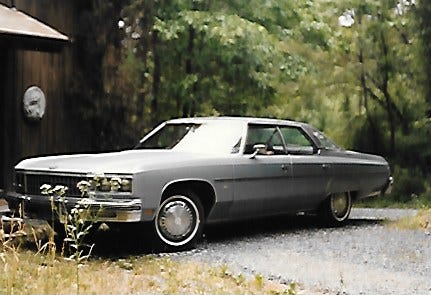
Pop pop’s 1976 Chevy Caprice Classic
My Pop pop wanted me to focus on my school work, and not get into the vicious cycle of working a job to pay for a car, and then repairs, since I would only be able to afford a junker. And he certainly didn’t want me driving one of those “Japanese roller skates.” So he kindly let me use one of his cars, and I paid the insurance. It was a metallic blue 1976 Chevy Caprice Classic. It drove like a ship floating on clouds. It was so solid that once, when I backed up at a friend’s house on a moonless night and hit his stone wall, the wall fell over and there was not a scratch on the bumper.
Back to my dad. Conversations with dad had a limited menu. He was an introvert who had pushed himself to be more comfortable in social interactions, which was ironic when you consider his line of work. We would talk about cars, sing along to music on the radio (he had a good voice and a hilarious falsetto that would show up with certain Beach Boys songs), share commentary about the attractive women we saw, and not a lot else. This reparte about women was an oddly uncomortable ritual we shared. I wasn’t really into sports; if I was, we probably could have engaged in this pseudo-language that so many men use as a proxy for meaningful conversation. I’m sorry, but it’s always seemed like a farce to me. Rather than talk about what is really going on in their lives, some guys can just spend hours talking about teams, players and plays.
It was instructive for me to see and know what it was that my dad did for work. I admired him for it, even if I didn’t aspire to it myself. I could tell that he was good at it, and that his customers liked and respected him.
The physical memories I have of being in the company of my dad are of being small, and feeling myself a boy, even when I had grown into adulthood. He was a solid six feet tall, held himself with good posture (some would say a military bearing), and always took care to stay fit with tennis, volleyball, and weightlifting. Near the end of his life, when he had been ill and lost a lot of weight, I saw more of myself in his thinner physique. When there were opportunities to help care for him, I was able to take them because of the friendship and support of my wife. These were poignant moments which matured my sense of self. This twilight time let us both see each other with clarity, an openness that came with approaching death, and speak words of acknowledgement about each other’s goodness, and the good women we had each married.
RECENT PAST
Before my father died, my wife and I had been considering moving out ofPhiladelphia, our home of the time. Violent crime had touched our lives multiple times, which was its own travail, but there were petty crimes that wore us down too. We’d had a beautiful Ficus plant in the courtyard we shared with five other neighbors, and when workman were doing repairs on one of the houses, it disappeared. Or early one summer morning I heard sounds below our bedroom window which were unexpected; the garbage truck had been by around 4am, and this sounded like more garbage can rustling. I got out of bed in time to see our sole garbage can, which had our house and street number spray painted on it mind you, being loaded into someone’s trunk before he took off.
Dad left us some life insurance money, and we decided to make a break for it. While we kept working, we began diligently researching new places to live. We lived in what Philadelphians call a Trinity (Father, Son, Holy Ghost) which is essentially a tiny house with three floors—or rooms— stacked on top of each other, and a narrow winding staircase. They were popular with ship’s captains and their families in the 1800s. The walls of our first floor were covered with newsprint lists of what we were looking for in a new home. Then the day came that we quit our jobs, hired a teenage neighbor to watch the cats, and hit the road. We covered a lot of territory in the next month, on both coasts of the US and plenty of places in between. Ithaca, NY was one of our first stops on the list, and ended up being the last as well.
Thinking about our travels and the many stories I could tell, I landed on one which relates to our visit to Boise, ID, and a spectacular dessert. If you’ve never been to Idaho, I highly recommend it. Some of the most beautiful vistas in the entire United States are in Idaho. My only words of caution are that if you have a car festooned with progressive liberal bumper stickers, you might not want to be driving through the Snake River Valley after dark. The gun racks in the cabs of those pick up trucks have real guns in them, and the drivers may not be fans of Brandon—or Prius owners.
You don’t have to be from Philadelphia to know what a Tastykake is, but for many a Philadelphian, it has been considered haute cuisine for more than a hundred years. I certainly enjoyed a butterscotch Krimpet in my day, but my wry reflection is that any product which substitutes a K when common English would call for a C is…suspect.
So, we were exploring Boise’s potential for our future, and on our first night in town we went to a nice restaurant. It had high ceilings and timberframe interior, with the trophy heads of many big animals on the walls. After an exceptional meal, we ordered the dessert special. When it arrived, I paused in reverence. There was a handmade ginger cookie of sorts, like an upside down hand with delicate fingers spread open, holding a scoop of vanilla ice cream with a dark chocolate drizzle, probably a few strawberry slices and a leaf or two of mint. It tasted even better that it looked. When I came up for air and wiped my lips with my napkin, I met my wife’s eyes, and she uttered words that shall live in infamy. “You know, that was beautiful, and tasted amazing, but sometimes…you just want a Tastykake.”
PRESENT
2011 Volvo C30
Tomorrow I’m going on a road trip to Selden, NY, after a ferry ride across Long Island Sound, where I’ll meet a fellow named Zee, and try to take an old Volvo C30 off his hands. If there are any C30 enthusiasts out there, please give us a little shout. The C30 was made from 2006-2013, in two generations. Volvo made about 220,000 of them, and it was meant to be an appetizer to Volvo ownership, leading buyers up the food chain after they got the little coupe experience out of their system. That worked in a sense, because 3 out of 4 people who bought the C30 were first time Volvo buyers. It’s not as sporty as your little Mazda Miata, but it’s classy—and cute. Five cylinders of tranversely installed inline horsepower makes it go vroom! No, I’m not having a midlife crisis. Yes, I’m channeling my Pop pop and dad…it’s my inner Marsland motorhead coming through.
While I’m on a road trip, I hope that you’ll be digesting three clinical updates. The first is courtesy of a patient who wrote a very detailed summary of her response to the clinical interventions we have tried to date. In particular, she credited Baobab with a wide range of improvements including decreased joint pain in previously injured areas, and return of hair growth and luster. When she attempted to reach the 1 Tbsp dose in 16oz of water, sipped over at least eight hours which I had suggested, all mayhem ensued. This could be interpreted as provocation of her MCAS, in particular provoking her paresthesias. Fortunately, she didn’t give up on Baobab, and with some trial and error, discovered that by dosing as little as 1/8 tsp, and no more than a flat 1/4 tsp daily, she could get marvelous benefit without any adverse effects.
The second update to share is the name of a product for heartburn which has been very helpful to patients trying to wean off of proton pump inhibitors (PPIs). Reflux Gourmet is a clean product made with sodium alginate from brown seaweed or kelp. It has two flavors: Chocolate Mint and Vanilla Caramel. I like them both, but particularly enjoy the Vanilla Caramel, as it reminds me of the Werther’s caramel chews of my boyhood. Once taken, the alginate forms a protective coating in your throat, esophagus, and stomach that can help relieve or even prevent manifestations of reflux. When the alginate reaches your stomach, it forms a protective gel “raft” that floats on the top of your stomach contents. This raft effectively blocks off (or “corks”) the esophagus, physically blocking the reflux of your stomach contents into your esophagus.
Reflux Gourmet was recommended to me by our dear colleagues at Vitahealth Apothecary in NY, NY. It is widely available, and the cost is about $25-37 online. Each tube contains forty seven doses, and it can be used up to four times a day, after meals and at bedtime.
The last update is about a type of medical device on the market which delivers microimpacts. I spent a mind-blowing two hours in conversation with Peter Simonson, President of Juvent, a company which makes a very high quality and safe form of microimpact device. Our visit was revelatory, because of what I learned about bone as an endocrine and metabolic organ. Bones are so much more than the structure on which we hang our meat suit.
Pierre and I both have one of these devices and use them personally. FDA approved use of the Juvent is to reverse osteopenia and osteoporosis, but the clinical applications are much broader. This device has been on the FLCCC Alliance protocol as third line therapy called low magnitude mechanical stimulation. Page thirty two of the I-RECOVER protocol reports:
Low Magnitude Mechanical Stimulation (LMMS or Whole-Body Vibration). Low magnitude (0.3-0.4G), high-frequency (32-40 Hz) mechanical stimulation has been demonstrated to increase bone density as well as indices of general well-being in patients with a variety of medical disorders. It is postulated that this intervention recruits bone marrow stem cells in addition to having metabolic and immunologic effects. In humans, low-magnitude acceleration is applied through the feet by standing on a platform oscillating at relatively high resonant frequency. These parameters are very safe, painless, and easy to administer. This therapy is offered by Physical Medicine and Rehabilitation Centers, or a device may be purchased for home use https://www.juvent.com/health/) similarly with noninvasive brain stimulation (NIBS).
A study referenced by the protocol is:
Mogil RJ, Kaste SC, Ferry RJ, Hudson MM, Howell CR. Effect of low-magnitude, high-frequency mechanical stimulation on BMD among young childhood cancer survivors. A randomized clinical trial. JAMA Oncol. 2016;2:908-15.
What I want to say about this therapy is that there are many knock-offs on the market, and most of them are likely to harm you. They are the equivalent of standing on one of the machines in Lowes or Home Depot which is used to shake up paint. While our bones are designed to handle mechanical vibration at this level, the rest of our organs, including our brain, are not. Juvent operates at very safe 0.3 – 0.4 g’s of energy between 32Hz-37Hz, and detects the user’s resonant energy to use this energy effectively. Since I have delved into the science behind this product, two of my patients bought knock-offs, one at the recommendation of her Physical Therapist, and I had the bad luck of having to tell her she wasted her money for something that would probably hurt her.
The Juvent is an expensive piece of equipment, costing $6,000. It is also made in Tennessee by well-compensated American workers, using aerospace grade aluminum, gold-plated microprocessors, and strongly patented technology which cannot be easily imitated. It is my hope that with future case studies exploring some of its potential uses for patients with post-acute sequelae of COVID (PASC), vaccine injury, and cancer, that we will find ways to increase access through shared facilities.
P.S. I do not have a financial interest in Baobab farms, Reflux Gourmet, or Juvent—just an intellectual one!
When I was a very little boy, we lived in Horsham, Pennsylvania near an Air National Guard base. The drone of the large planes flying overhead was part of the soundtrack of my childhood. I assume that at least some of those planes were C-5 Super Galaxy transports. Monsters with two enormous engines on either side, they could carry heavy equipment and have brought the caskets of dead soldiers home to Dover, Delaware from many conflicts during and since the Vietnam War. In an odd twist of fate, it would turn out that my future father-in-law worked as a Flight Simulator Technician on C-5 flight trainers during his career in the Air Force and later as a civilian. The planes’ vibrations were so penetrating that there were resulting cracks in some of the storm windows on our porch.
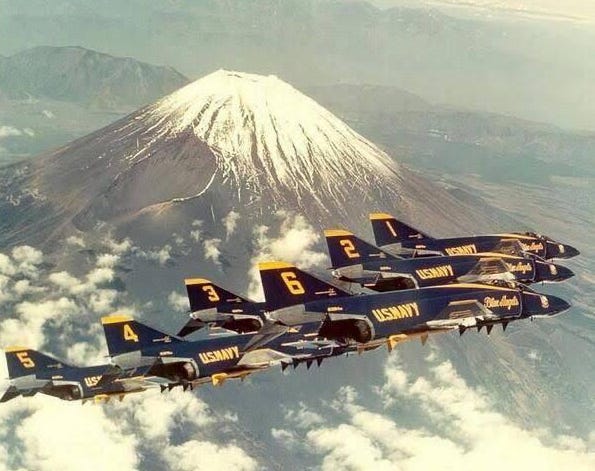
Blue Angels flying F-4 Phantoms
It was around that time that my family went to an air show of the Blue Angels. This is a squadron of elite pilots who are ambassadors for the U.S. Navy and perform aeronautical maneuvers to impress the crowd. When I was barely four years old, they were still flying the F-4 Phantom. The show captivated my imagination, and I remember that a few years later I was building the model plane versions of the Blue Angels’ F-4 Phantom. (Between the model glue and the paints that I used, my little brain got a fair amount exposure to VOCs those days!) With my paper route money, I was a regular at the model store downtown.
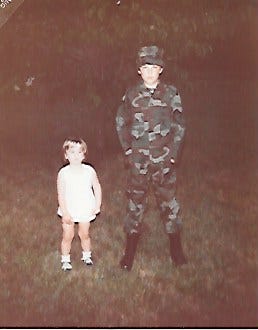
Cousin Stacey and me, the aspiring Marine
As a teenager I was drawn into the plot line of movies such as “The Great Santini”with Robert Duvall. By that time I was well aware of the rivalry between the U.S. Navy and the U.S. Marines, and living under the authoritarian thumb of a U.S. Navy Captain, my stepfather Em. His last reserve station was South Weymouth Naval Air Base in Massachusetts. Of course, I wanted to be a Marine. Most of the Santini storyline felt familiar and deeply personal, but especially the raw emotions of Lt. Col. Wilbur “Bull” Meechum’s son Ben as he sought to preserve his sense of self under the obliterating rules of his father. The plane which Duvall’s character flew was an F-4 Phantom. When you watch the aerial scenes, you’ll see plenty of black smoke, but only the occasional white vapor trail from the the jet engines.
When I later watched Duvall in Apocalypse now, I was enthralled. I swear it was an F-4 Phantom which delivered one of the napalm strikes, not an F-5 Freedom Fighter, but what does a kid know? Before the sounds of the fighter jet arrive, you could hear the radio call of a soldier on the ground: “I have a target for your fast-movers…Burn’em for me will ‘ya?” Later you see Duvall’s character, a surfing-obsessed Air Cavalry officer, bare-chested in his Union Cavalry hat proclaiming, “I love the smell of napalm in the morning!” It was F-5s that delivered the napalm that time, so that his guy could surf without pesky mortar fire. When we visited Myrtle Beach, SC for a family reunion in 1979, I found myself one of those cavalry hats, and would pretend to be Duvall’s character, “It smells like…victory.”
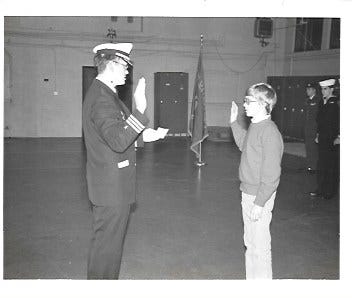
Swearing in for the U.S. Naval Sea Cadets Fall 1983
I aspired to become a midshipman at the U.S. Naval Academy, and my grades were certainly good enough. An indication of my serious intentions was joining the U.S. Naval Sea Cadets in the Fall of 1983. If I were to pick a year where my sensibilities regarding war and a military career began to change, I would say it was 1984.
Three of the five major father figures in my life converged at that time. I went to live with my Nana and Pop pop, and Pop pop had been a Marine who fought in Okinawa during World War II. More than once, in frustration with my irascibility, he would say, “I wish we could get you to Camp Lejeune and the Marine boot camp would straighten you out.” I had wanted to be a Marine, but that didn’t sound so good. He was reflecting back to me a sense that I was too wily for military life. My freshman social studies teacher, Mr Roger Breidinger or Mr B, opened my eyes to the pretexts upon which every war is started, from the sinking of the USS Maine before the American invasion of Cuba, to the Gulf of Tonkin in Vietnam. I learned about the Kent State shootings where the Ohio National Guard killed four and wounded nine unarmed college students on the Kent State University campus as they peacefully protested the war in Vietnam. I came home with questions about who the good guys really were, and that would get my Pop pop upset.
Larry MacKenzie, father of my friend Larami, introduced me to Quakerism. Incredibly thoughtful, a soft-spoken professor of English at the Community College of Philadelphia, Larry would gladly drive out of his way to pick me up and bring me to Quaker meeting on Sundays. He and his wife, Bonnie were the first adults I ever met who insisted that I called them by their first name, an early sign that their respect for my integrity and mind as a teenager was a notch above what I had experienced previously from any other adult.
Diagnosis with hypertrophic cardiomyopathy and open heart surgery at the NIH in March of 1985 put the official kabash on my military aspirations. But there was still a lot to sort out in my mind, between my fascinations, my dreams, what was true, what was right, and what I was going to do about it.
RECENT PAST
In 2007 my friend Melanie recruited me to come work in the Emergency Department (ED). She had transferred there a year before from the medical surgical floor that we both worked on at a small community hospital here in Ithaca. Shari McDonald, the ED Nursing Director at the time, had a more evolved perspective on nurses and our role in delivering care. She saw a spark in me, which prompted her to invite me to travel with her and another nurse to a Studer (now Huron) conference in Pensacola, Florida. I learned some important things about helping patients to move through the ED more efficiently, and setting up a program for follow up phone calls, which caught clinical deterioration early. Although I didn’t catch sight of them while I was there, I was aware that Pensacola, Florida is the home base for the Blue Angels.
Because my wife and I had a no-car household for a decade and then a one-car household for an even longer period, I would use a combination of carpooling to work with my friend and fellow nurse, David, biking, or riding the bus. At the time there was a bus driver named Ray who I became pretty friendly with. Ray is a mountain of a man who runs a private hunting lodge and game farm, is a part-time lumberjack, bus driver, and former U.S. Navy Phantom F4 pilot. You can easily imagine that despite my Quakerly inclinations, I was fascinated to hear about his experiences as a pilot during Vietnam.
Ray is a tough guy. Having worked in the emergency setting for sixteen years, I think I have some solid ground up upon which to describe my observations of how different people handle pain. The first thing I’ll say is that women have the upper hand, without a doubt. Childbirth is the benchmark, but I think you can peg kidney stones above that. With men, it’s a crapshoot. But Ray was in a category by himself. He told me a story of lacerating the palm of his hand during a log splitting mishap. He went to the ED and when the suturing physician said he was going to use lidocaine to numb up the site, Ray told him that he didn’t need it. After some back-and-forth, the physician told Ray that if he truly didn’t need lidocaine during the entire process, he wouldn’t charge him. Ray’s hand was sutured and he was discharged home without a bill.
Most of the time we conversed at the front of the bus, I listened to Ray, because his daughter had developed MRSA and had a series of escalating healthcare events which ultimately led to her death. I have had plenty of encounters with MRSA, but this was the first time in my career that I had seen such a young person die as a result of complications from it. She was a single mother, and the daughter she left behind was four years old. Prior to that, I’m sure that Ray was looking forward to retiring from his job as a bus driver. Now he and his wife had a young granddaughter to raise and insurance to provide.
David and I worked together for seven years before I moved to the ED. There was a brief U.S. Navy connection for him. I’m vague on the details of how and why he left military service prematurely, but it makes perfect sense to me that such a brainiac would have been tracked to work in naval intelligence. It also makes perfect sense to me that he didn’t stay with the military, because he is one of the most peaceful-minded and out-of -the-box thinkers that I have known.
During our joint tenure at Cayuga Medical Center in Ithaca (CMC), the center hired a motivational speaker who was a former Air Force fighter pilot. Images of the planes and references to his glory days were part of his schtick. Exiting one of these presentations together, I witnessed a rare demonstration of anger from David, as he succinctly, said,”I don’t think that a former highly trained murderer is in the best position to motivate the masses.” In that moment, I realized he had clarity, whereas I had wrestled with uncertainty during years of fascination with military fighter planes, and the people who pilot them. My inner voice told me that there is something debased about mass killing from a distance. It started with modern warfare and has only accelerated in scale since.
PRESENT
If you haven’t seen The Matrix film seriesby now, you should. The basic plot is this: The Matrix is a computer-generated dream world designed to keep humans under control. Humans are kept sedated, effectively living a virtual life, and their life force fuels The Matrix. If you haven’t see The Matrix, what follows may not make as much sense to you. Simply put, I think of The Matrix regularly, as we are living in such a dystopian world where black is white and upside down is right side up.
Did you (who have seen The Matrix) ever wonder what happened on earth which led to the scenario of The Matrix? I did, and so did many others. The Animatrix is a 2003 American-Japanese adult animated science-fiction anthology film produced by the Lana and Lily Wachowski.The anime compiles nine animated short films, detailing the backstory of The Matrix , in addition to providing side stories that expand the universe and tie into the film series.
From The Animatrix: The Second Renaissance II –
The humans scorched the sky DURING the war.
Operation Dark Storm was done to cut off the machines’ primary energy source (solar power) using high-altitude bombers WHILE humans simultaneously launched attacks against them. The plan was to give humans the upper hand for a short period of time, while the machines didn’t have an alternate energy source yet.
This advantage didn’t last long since most of the humans’ weapons also depended on the sun, and their fragile bodies were no match for the machines’ resilient shells.
Bombers carry out Operation Dark Storm in The Second Rennaissance II
I’ve been an enthusiastic reader of science fiction for many years. In part, it is because science fiction writers have foreshadowed events occurring decades later. Yet these days, it seems that the time and distance between science fiction and current reality is rapidly shrinking.
I’ll tell you that four years into this pandemic, which many think is over, it’s a slog climbing up the hill to my office and settling into a day filled with patients still struggling with post-acute sequelae of COVID (PASC) and vaccine injury. What makes it possible to carry on, aside from the fact that I’m a persistent son-of-a-gun, is the fact that sooner or later, more or less, our patients are getting better. There is indeed an upward trend.
What consistently takes the wind out of my sails and challenges my spirits, is a glance to the sky as I leave our home each morning. What starts off as a clear blue sky, takes a sinister turn as the jets appear and begin laying down their vapor trails. It has happened so many days now, that the pattern is predicable as, well, the weather, and I’m astounded that I don’t hear more people talking about it. I’m adept at pattern recognition; it is an important quality which makes me an effective clinician.
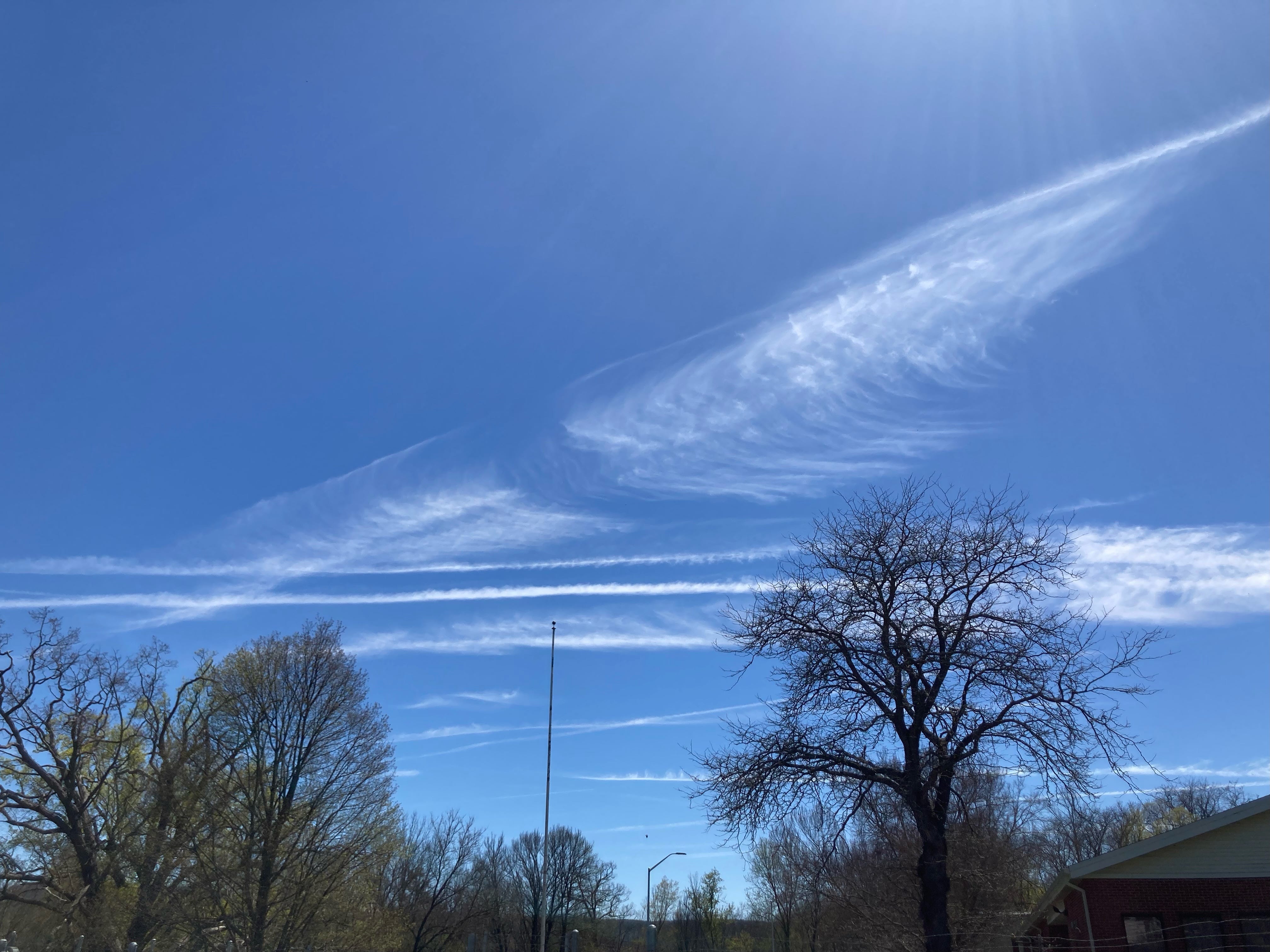
I see patterns to the vapor trails. I have paid attention to military planes my whole life. These jets are not commercial airliners taking off from the Tompkins County Airport. These are military planes, or drones; there are often four, or five, and they systematically criss-cross the sky, laying down their trails. They don’t take off for holidays or weekends. They fly at all times of the day and night. What then happens is the sky becomes covered with a haze, the sun and the blue blocked out. What often happens in the day or days to follow, is that it gets colder, and we have rain and wind.
Vapor trails above Ithaca 4.26.24
Before I went on my recent road trip, I only knew what I have been seeing in Ithaca for at least the last year. As I headed to Long Island, dipping south near Pennsylvania, crossing through Connecticut, to Long Island and back to Ithaca, I saw vapor trails everywhere along the way. The scale of these operations boggles my mind. The money, the human resources, the fuel expended, and sheer number of jets in the sky, everywhere…is deeply disturbing. This is new, it is not normal, and it is not good.
The ongoing daily theft of the common good, blue skies and sunshine is by itself a crime against humanity. As a reader of prescient science fiction, knowing that there are arrogant humans who think that they can outmaneuver nature and manipulate the seasons and weather in order to counter perceived global climate changes, well, the vapor trails are ominous. As a healer, attempting to treat thousands of people who have been and continue to be poisoned in an ongoing campaign of collusion between Big Pharma and captured governments, I’m suspicious of what these vapor trails really signify. I know that we have already been betrayed, but would the evildoers be so bold as to carry out further poisoning by light of day, in the very skies above our heads? Why not?
I wonder if these jets have humans in them, or if they are drones piloted from central locations such as Hancock Air Force Base in Syracuse, NY. I wonder if these jets are in the skies all over the world; a colleague in the UK has sent me pictures of the same images in skies above her home. I wonder if the men and women who pilot these jets know what the true mission is, or are being told lies. I wonder if they are courageous enough to uphold the U.S. Constitution, and protect fellow citizens from all enemies foreign and domestic. I wonder…if they are people just like my friend Ray, who was once young and enthusiastic, very technically skilled at carrying out orders which meant death for those on the ground.
I don’t know what these vapor trails contain, but my own eyes and mind have observed that they obscure the sun, steal the blue skies, and bring cold and rainy days. I have a patient who draws a clear temporal association between the day a sky was filled with vapor trails, and the demarcation of her chronic chronic illness. I know that this is not what has been, and it feels very, very wrong. I’m curious who else has noticed, what is known, and what might be done.
Vapor trails preceding cloudy skies and rain in Ithaca 4.24
Before hyperactive was a diagnosis truly in vogue, it was applied to me, and I was medicated with Ritalin. The doctor who prescribed it was a kind looking man with a deep, resonant voice name Dr Robert Allyn Kramer. He was a mensch; a kind and gentle man with impeccable credentials who died too young. Yale graduate, leader, educator and author in the field of child and adolescent psychiatry, president of his synagogue, he was even president of a non-profit arts organization. Who would have thought that a dear and trustworthy person could prescribe a drug that would addle my brain for decades? Certainly not me.
Dr Kramer was always seated behind his enormous desk, looking across the organized surface of it at little me in an oversized chair. He wore these half-lens reading glasses which made him look like the scholar he was. He was dressed in a suit, with pressed oxford and tie, and I remember he had a faint scent of something which smelled both manly and clean.
Getting down on the floor and playing with blocks wasn’t Dr Kramer’s style. It seems so odd to me now, that this imperious behind-the-desk approach was considered effective. It certainly reinforced the aura that he was the authority, and in control of the situation.
When I reached my teen years and was introduced to Re-Evaluation Counseling or RC, I began decades of work to try and recover my brain from the wreckage of my youth, while still emerging from it. Not until I was eighteen years old and joined a men’s support group one summer in Philadelphia, did I began to suspect that the Ritalin had a legacy for my mind. To put it in a sentence: as smart as I am, I still have to work pretty hard at learning and comprehending, and I think this is because of the years I was on that drug. Anyone who has spent much time around me, my wife especially, may have experienced the frustration of getting a quick and brief answer to a question. Sometimes what they get is silence, and aren’t sure if I heard them. This is more understandable in recent years as the COVID shots rendered me a candidate for hearing aids with persistent tinnitus, so I don’t always hear the question. But what it happening in my head, is that the wheels are turning, and I’m thinking. It’s kind of like trying to get up to 60mph in second gear, which by the way is kind of fun in the weathered Volvo C30 I just acquired, but not as much fun for the person listening and waiting for a reply.
MORE RECENT HISTORY
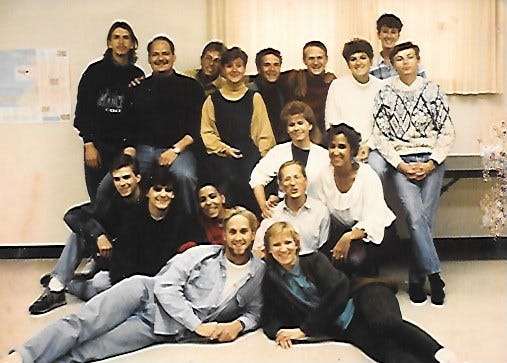
BVS Orientation San Francisco Summer 1991
After college I volunteered with the Church of the Brethren or BVS. The Church of the Brethren (COB), Mennonites, and Quakers are three Protestant denominations with a history of pacifism. The Quakers have the American Friends Service Committee, which doesn’t have as many volunteer opportunities for entry level positions as the Brethren Volunteer Service (BVS), and the Mennonites mostly have Mennonite volunteers. We had our orientation in San Francisco, and for three weeks, the men and women in my group slept on the floor in a COB church basement, and shared meals which we cooked in the church kitchen. During the week we would each spend time visiting a room which had dossiers on the different potential volunteer assignments and engaging in discernment about what our first, second and third choices would be.
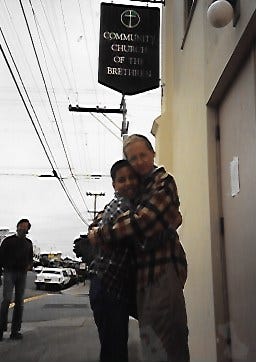
Laura and me in San Francisco
As you can see from the group photo, we were a young group, and the three weeks we spent together was an intense period of spiritual and personal exploration. It’s easy to be attracted to people when they show their inner selves with honesty and vulnerability. This was a particularly dynamic and vivacious cohort. During the next two years, I fell in love with multiple people, and have had plenty of time to reflect upon what drew me to each of them. Above is Laura, with whom I had a fleeting romance during orientation. She was a foot shorter than me, but strong enough to lift me up like a feather. Her heart was pure and true. If I had my head screwed on straight, I would have figured out how to keep that connection for a lifetime.
In reviewing our potential assignments, I was really drawn to one related to sustainable agriculture, but the opportunities were slim. There was a farm in Ireland, and one in New Mexico, but either the slots weren’t open (Ireland), or they didn’t think I was the right person (New Mexico). I don’t clearly remember how I ended up at a homeless shelter for families in San Antonio, TX, but I did. It was a Catholic Worker House on the East Side, a primarily African American neighborhood, which was sketchy at a time when crack was big and gangs were picking up speed. I sported a ponytail down to my butt and being a skinny white guy with John Lennon gold-rimmed glasses, stood out like an Ostrich on a chicken farm.
The Catholic Worker movement was started by Dorothy Day and Peter Maurin during the Depression in the 1930s. Dorothy Day’s life and legacy is a radical movement, faithful to the Gospel and the church, immersed in the social issues of the day. In 1933, they began publishing a paper called The Catholic Worker, through which they encouraged people to live out the ideals they wrote about, founding “houses of hospitality” for the poor and “farming communes” for the unemployed. The simplest way I can describe their ethos was to enact the Sermon on the Mount, which is a collection of sayings spoken by Jesus of Nazareth found in the Gospel of Matthew that emphasizes his moral teachings.
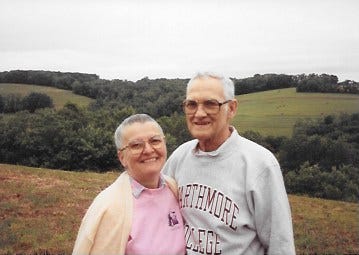
Homer and Rosetta Fry
When I first arrived at the San Antonio Catholic Worker, there was an eclectic assortment of volunteers. Homer and Rosetta were a retired couple from Indiana. He had worked for Indiana Bell as a lineman, and she had been a foreperson at a Singer Sewing Machine factory. Homer was super chill, and Rosetta was pretty high strung. She had developed a habit from years of supervising people to repeat everything she said twice. “Scott, you need to go collect the donated produce before breakfast. Scott, you need to take the truck and collect the donated produce before breakfast.”
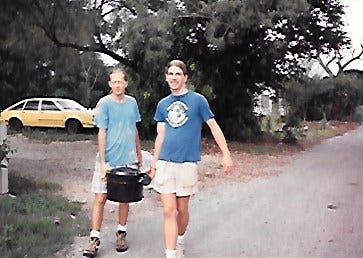
Me and Joel at the CWH, carrying hot water to dunk recently slaughtered chickens and pull their feathers
Matt was a Minnesotan frat boy who had done something vaguely illegal and was doing community service. Joel was another BVS volunteer, who had been in my orientation group, and came from an established COB family which had a organic farm in Ohio and was famous in their own circles. (For reasons I never understood, he saw me as a competitor, and later on, he would ally himself against me with Phyllis). There was a young hetero couple who came from I-don’t-remember-where. I just remember that they had each other and a working car, and were planning to have lots of kids. There was Heila, a red-headed German in her fifties who owned an art gallery back in Germany, and was taking a few months to work on her English and explore the underbelly of America. Ulla was another German volunteer who had a primary education and language therapy background. Then there was Phyllis. She was a BVS volunteer who had been at the Catholic Worker for nearly a year, and had worked at the BVS headquarters in Elgin, IL.
We all attended, well, except for Matt, a community Mennonite church. There was a contingent of Mennonite volunteers, kind of like us BVS volunteers, except that they had their own house, with an older couple who were the house parents and kept watch over the youngsters. In retrospect, I can see how very wise this arrangement was, because soon after Homer and Rosetta completed their volunteer assignment and departed, the organic stability which resulted from their elder’s wisdom began to dissolve. Then Heila left, then Ulla left. The remaining twenty-somethings energy became a bit contentious and our relationships suffered.
Given the passionate ideology and religious fervor which we all shared, it isn’t actually surprising that our community became fractious. Unfortunately, I became the lightning rod for this bad mojo. My sense of where things went south for me personally relates to Phyllis. I can’t say this without sounding like a shallow cad, but Phyllis was one of the ugliest humans I have ever met. It wasn’t just an external ugliness, although her disproportional lumpiness, bad hair and unique facial features were challenging to behold. But she was the living antithesis of Christian acceptance, and was strident in her wokeness, decades before woke was part of the lexicon. Matt drove her crazy, because he was a beer-drinking, baseball-watching frat boy, registered Republican, and when they worked the soup kitchen together, he would listen to Rush Limbaugh. Her daily rants about Matt were tiresome.
Phyllis
That shouldn’t have been my problem, but Phyllis fell in love with me. It was obvious. Have you ever had someone else’s dog with a hard-on try to hump your leg? It’s never comfortable, but it really doesn’t help when the owner stands there as if nothing is happening. So, Phyllis fell in love with me. To say that I wasn’t interested is an understatement. But to make matters worse, I was falling head over heels in love with one of the Mennonite volunteers from our church, Theresa. Ooooff! A curly haired beauty with a kind spirit who ended up becoming a minister’s wife.
From left, Joel’s Mennonite girlfriend (future wife?), my love, Theresa, and me
Phyllis may have been delusional, but she had eyes, and she saw where mine were looking, so of course she befriended Theresa, then proceeded to push the issue with me. Have you ever seen the connived workings of Livia in I Claudius? In our community meetings, Phyllis asserted that I was not acting as a friend to her, and well, because we were living in a Christian community, I needed to be her friend. I didn’t see it quite the same way. To me, we needed to be respectful and cooperative in our endeavors, but friendship was a matter of free will and proclivity. It got worse, as Phyllis continued to push her demands for closeness upon me, and the harder she pushed, the more vocal I became. After living in Philly for a decade, I would say that I got Philly on her. Back the f___ up before I tune you up. That was a mistake.
There isn’t a clause in some Catholic Worker handbook somewhere about excommunicating unruly members, in part because historically, Catholic Workers have attracted civilly disobedient roustabouts who are inherently unruly, right down to their haircuts or lack thereof. But excommunication is a fair word for what happened with me. In the end, I was voted off the island, so I lost the girl (Theresa agreed to a last dinner out before I left San Antonio), the current assignment, and even my next assignment (I had been accepted after all to volunteer at the farm in New Mexico). It was quite dramatic and traumatic. I got sick as a dog and was in bed for a week, laid up in the home of an older lesbian couple I had befriended through Dignity, a GLB Catholic organization with which I had attended services while in San Antonio. A decade later, there was a reunion of volunteers at the CWH in San Antonio. They actually invited me, and I almost went, then I thought the better of it and stayed put in Philadelphia. Some battlegrounds aren’t worth revisiting.
PRESENT
Before I begin this last section, I want to remind each of you, dear readers, that this is not meant to be individual health advice. Individual questions pertaining to your unique history and questions are not within the scope of my responses when writing this Substack. Please consider becoming a patient by going to our website. If you are an existing patient, please address this in the context of a visit, your overall clinical condition, and response to current therapies in your plan of care.
In the last two months I have made a lot of work for myself by ordering ZRT urine neurotransmitter testing on nearly eighty patients. I spend up to an hour reviewing the results for each patient, considering their clinical course and individual plan of care. I work feverishly to get caught up, then six more results come back and I’m in the hole again. My colleague in The Leading Edge Clinic, India Scott, FNP-C, has been doing neurotransmitter testing like this for more than a decade. I’d finally had enough (and maybe she did too!) of asking her to translate the results for me, and dedicated myself to the task.
You might wonder why your neurologist, psychiatrist or PCP doesn’t use this testing. Easy. Insurance doesn’t cover it, and the captured medical journals haven’t published articles about them, validating their use in formulating effective treatment plans. That doesn’t mean we can’t use accessible tools like this to help our patients heal.
What I have found during my lab reviews is a jaw-dropping, global disregulation of neurotransmitters in patients across the spectrum of pathologies and symptoms. The spike protein has disregulated all of us, and there are things which we can do about it. It helps to have a little peak under the hood in order to guide interventions.
One noteworthy point is the difference between people who had pre-Omicron COVID, and pan- or post-Omicron COVID. As I presented in October of 2023 at the second FLCCC conference in Fort Worth, TX, we had great results using Memantine in patients with cognitive and emotional disregulation. We understood that glutamate levels in the brain were elevated as a result of the spike protein, that high glutamate levels are neurotoxic, and that Memantine is a glutamate antagonist which gently lowers glutamate levels. But at a certain point, Memantine stopped working as well for as many people. Reviewing neurotransmitter results, I can now see that some people have low normal or low glutamate levels, and using Memantine would make matters worse. Only a couple of patients have had elevated glutamate levels on the ZRT testing which I’m using.
Another noteworthy point is that many patients have low tryptophan and low serotonin. This is precisely what the UPenn researchers pointed to in their study of post acute sequelae of COVID (PASC) patients in their clinic: spike inhibits tryptophan production in the GI tract. Tryptophan is a raw material for T-cells (think reactivated viruses), melatonin, nicotinamide and serotonin. The tryptophan highway is blocked by a jack-knifed eighteen wheeler, so we can’t merely eat a lot more turkey. What can we do? UPenn researchers identified this also, recommending the use of 5-HTP, which produces tryptophan via a different pathway. In patients who I started on 5-HTP prior to the ZRT testing, we could see tryptophan normalizing, and serotonin levels in normal or high normal range with concurrent improvements in mood and cognition.
What about Lithium Orotate? Dr Michael Nehls, the neuroscientist from Germany, has been talking a blue streak about Vitamin D and Lithium Orotate to protect our brains from the onslaught of spike. Pierre and I had the pleasure of a private meeting with Dr Nehls nearly two months ago, and he helped us understand that Lithium Orotate was a key tool in the fight to reclaim our brains in general, and hippocampi in particular. If therapeutics such as Vitamin B6 (as P5P 50), or 5-MTHF, or L-Theanine are useful to rebalance specific neurotransmitters, then Lithium Orotate is a general tonic which helps rebalance all neurotransmitters, because it reestablishes neuronal connections, decreases neuro inflammation, and enables the brain to start making new neurons. The particulars for inidividual patients have proven to be nuanced. I generally start with 130mg, but India prefers to start with 20mg of Lithium Orotate and work up to 130mg, stopping if clinical benefit is achieved earlier. Dr Nehls strongly recommended 130mg for symptomatic patients, dropping back to 20-30mg for maintenance when stability has been achieived. It’s important to note that 20-30mg of Lithium Orotate equals 1mg of active Lithium and 130mg of Lithium Orotate equals 5mg of active Lithium.
Because most health professionals, and many laypeople have preconceptions about Lithium as solely the province of psychiatry and bipolar schizophrenia, it’s important to note that we are talking about Lithium as a trace mineral. Would you be concerned about toxicity from a pinch of Celtic sea salt in your water, or 25mg of Vitamin C? No. Neither should you be concerned about trace amounts of Lithium which are many times less than the doses used in psychiatry. You can get 1mg of active Lithium by drinking a pricey bottle of San Pelligrino mineral water, or eating a lot of seafood, but you’ll also quickly empty your wallet, and in the case of seafood, there are so many toxins in the ocean that you’ll poison yourself with mercury before you reach therapeutic levels of lithium. And it’s cheap, cheap, cheap. Horbaach makes a 130mg capsule of Lithium Orotate which costs $15, including shipping, and provides six months woth of the supplement.
My parting thought is regarding MRIs of the brain with a NeuroQuant study. Our beloved colleague Dr Suzanne Gazda has been recommending this test for more than a year now. I don’t think it is financially viable or practically necessary for every patient we see, but the results of the handful I have reviewed are stunning. Patients’ neurological status may have subjectively improved, and they feel themselves returning to their baseline level of cognitive function. Then they get a NeuroQuant and find that their hippocampus is shrinking, and registers in the 2nd, or 12th, or 22nd percentile. Dr Nehls is right. The spike is targeting our brains in general, but our hippocampi in particular, and we need to fight back.