
Introduction: The Wrong Question About Reinfection
Every time a new COVID variant emerges, the public health conversation follows the same script. Is it more severe? How many mutations does it have? Will the current vaccine protect against it (hah!)? Are hospitalizations rising?
For people with Long COVID, Post-Vaccine Syndrome, or any history of spike protein-related illness, they are almost entirely the wrong questions.
The correct question isn’t whether the COVID, or the latest variant Cicada variant (BA.3.2), causes more severe acute illness than previous strains. The correct question is: what does each additional COVID exposure do to someone who already has persistent spike protein, ongoing cellular senescence, and an immune system that never fully resolved the first round?
The answer, supported by emerging research from scientists at the Vedicinals group and consistent with what we observe clinically, is deeply concerning. It is also largely absent from mainstream COVID coverage.
This post explains why reinfection matters in a way that the standard messaging doesn’t capture, what the Cicada variant means specifically for this patient population, and what can be done to reduce the biological cost of repeated exposure.
What the Cicada Variant Actually Is
As of early April 2026, BA.3.2 has been detected in more than half of US states, according to the CDC. The WHO classified BA.3.2 as a variant under monitoring in December 2025, citing the variant’s many mutations and substantial antibody escape.
What makes Cicada notable is not its acute severity, but its spike protein. Compared to the current predominant strains of SARS-CoV-2, BA.3.2 carries 70 to 75 genetic changes in its spike protein. Of course, we alredy know the spike protein drives fibrinogen misfolding, mast cell activation, endothelial dysfunction, microclotting, and cellular senescence in Long COVID patients. But, Cicada’s mutations may help it evade antibodies. In a patient population where immune dysfunction is already significant, this is something Long COVID and Post-Vaccine Syndrome patients need to take note of for reasons explained later in this post.
Importantly, early data suggests BA.3.2 does not cause more severe acute disease than recent variants.
For the general public, that assessment is probably reassuring. For patients with existing spike protein burden and senescent cell accumulation, it misses the point entirely.
The Framework That Changes Everything: Spike Persistence and the Senescence Cascade
To understand why reinfection matters so much for this patient population, you need to understand a mechanistic framework that is only now beginning to enter the scientific literature, and that we at Leading Edge Clinic have been treating clinically.
A recently published paper from researchers at the Vedicinals group and collaborating institutions advances a hypothesis that brings together two phenomena that have been observed separately but rarely connected with sufficient clinical clarity – persistent spike protein production and progressive cellular senescence.
The key insight is this: Long COVID may not be primarily a problem of “how much spike is left over” from an infection. It may be a problem of ongoing spike production from a small population of cells that never stopped making it.
The Persistent Producer Cell
The paper proposes that a small number of cells, potentially harboring viral RNA in protected intracellular compartments called double-membrane vesicles, or having integrated spike-encoding genetic material, continue to produce and release spike protein long after the acute infection resolves. These “producer cells” generate modest amounts of spike individually, but their output is continuous, and it accumulates in tissues over time.
This would explain a striking observation from a high-volume European Long COVID diagnostic laboratory: spike protein detectability in Long COVID patients rose from roughly 30–40% in 2024, to approximately 75% in the first three quarters of 2025, to 96.5% by the fourth quarter of 2025. Under a simple “leftover antigen slowly clearing” model, you would expect a declining curve. A rising curve points toward ongoing production – an active source term, not residual debris from a resolved infection.

How Spike Spreads Beyond the Original Source
The paper outlines several mechanisms by which spike from a small number of producer cells can reach a vastly larger number of healthy cells:
Extracellular vesicles (exosomes). Spike protein packaged inside exosomes can evade antibody neutralization. Antibodies can’t bind to what they can’t reach. These vesicles carry spike through circulation and into tissues, delivering it to cells that never encountered the virus directly. These are the same vesicles by which proposed spike protein shedding events occur.
Syncytia formation. When spike-expressing cells contact cells with ACE2 receptors, they can fuse, creating multinucleated structures. Each fusion event effectively transfers spike-producing capacity to multiple adjacent cells simultaneously. What does this mean? It means a single producer cell can transfect 5–20 neighbors in one fusion event.
Tunneling nanotubes (TNTs). Cells can form thin, direct membrane bridges to neighboring cells through which spike protein, vesicles, and potentially viral RNA can transit — entirely shielded from antibody neutralization. A spike-producing cell may maintain TNT connections with 5–50 neighboring cells at once.
The result is progressive tissue saturation: a small upstream source driving a disproportionately large downstream burden.
The Senescence Cascade
The senescence cascade is where the model becomes clinically relevant.
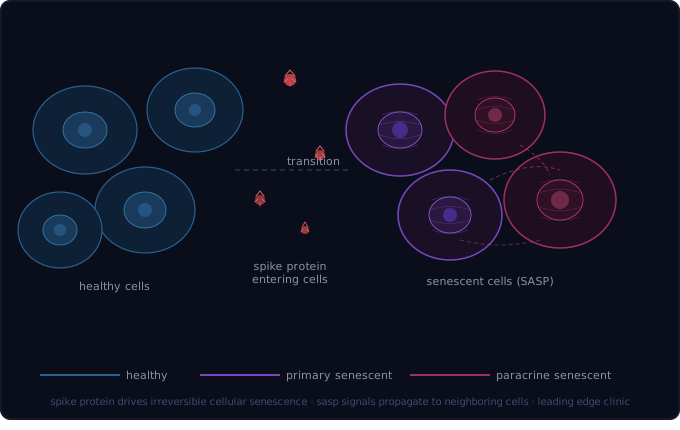
As cells accumulate spike protein intracellularly – whether through exosomal uptake, syncytia fusion, or TNT transfer – they experience proteostatic stress, ER stress, and DNA-damage-response signaling. Once these signals cross a threshold, the cell enters a state of irreversible growth arrest: cellular senescence. It stops dividing, resists programmed cell death, and begins producing a continuous stream of pro-inflammatory signals collectively called the SASP — the senescence-associated secretory phenotype.
But the most important feature of senescent cells is that their SASP is contagious.
SASP factors — IL-6, IL-8, IL-1β, TNF-family molecules, matrix metalloproteinases — induce senescence in neighboring cells that may contain no measurable spike antigen themselves. This bystander or paracrine senescence means the lesion expands far beyond the originally spike-exposed population. Cells that never encountered spike become senescent because they were next to cells that did.
This creates a self-amplifying cascade that the paper describes precisely: the disease can transition from a spike-driven initiation phase to a senescence-dominant maintenance phase. In this case, the symptom burden becomes partially decoupled from measurable spike load. Patients remain severely symptomatic even when standard tests don’t detect viral material, because the biology has “handed off” from an antigenic driver to a self-sustaining cellular program.
This is consistent with what we observe clinically in Long COVID patients who have been ill for two, three, or four years. It is also consistent with why therapies aimed purely at viral clearance often underperform in established disease.

Why Each Reinfection Layers Onto This Foundation
Each additional COVID exposure, whether from Cicada, any other variant, or a future strain, adds a new round of spike protein input to a system that is already struggling with ongoing production, progressive tissue saturation, and expanding senescent cell burden.
It replenishes the upstream source. A reinfection doesn’t just cause acute illness and then clear. It potentially seeds new producer cells, adds to the extracellular vesicle pool carrying spike, and re-exposes tissues that may have been recovering toward a threshold. The spike positivity data from the Vedicinals group’s European laboratory is consistent with this: a population of Long COVID patients showing rising, not declining, spike detection over time. Reinfections accelerate what was already an accumulating burden.
It compounds the senescence burden. Each new wave of spike-driven senescence induction is additive. Primary senescence from new spike exposure layers onto existing senescent cell populations. The paracrine cascade expands into new tissue territory. Patients who were at the margin of clinical stability (still functioning, managing their condition) can cross a tipping point following reinfection into significantly more impaired states.
The Cicada variant’s immune escape makes it more likely to establish a productive reservoir. For a Long COVID patient whose immune system is already dysregulated and whose neutralizing antibody response may be quantitatively or qualitatively impaired, a variant with enhanced antibody escape has a higher probability of establishing persistent producer cells rather than being rapidly cleared.
The spike protein variant may matter. The Vedicinals paper notes that earlier variants, including Omicron, appear to induce higher p16 and p21 expression (markers of cellular senescence) than ancestral strains, despite causing less severe acute illness. Cicada’s 70–75 spike mutations represent a distinct protein configuration. Whether this configuration affects senescence-induction kinetics is not yet established, but the direction of the existing data (that newer variants may be more senescence-inducing despite less acute severity) is something this patient population needs to take seriously.
The acute illness is not the danger. The downstream biology is.
This is the core message that is absent from every piece of mainstream Cicada variant coverage. The question “is it more severe?” is answered by hospitalization rates and ICU admissions. It does not capture what happens over the following 6, 12, or 18 months in someone already carrying significant senescent cell burden. It does not capture the cumulative cost of each reinfection to a biological system that has been running in a state of chronic dysregulation.

The Role of Senolytics: Reducing the Cost of Repeat Exposure
If the senescence cascade model is correct, and the evidence is increasingly consistent with it, then one of the most important things a Long COVID patient can do in the context of ongoing variant circulation is actively work to reduce their existing senescent cell burden. This reduces the foundation onto which a new exposure would layer, and it may limit the propagation of any new senescence cascade.
This is not a new clinical concept for us. Senolytic interventions (agents that selectively clear senescent cells) have been part of our treatment framework for Long COVID and Post-Vaccine Syndrome.
Some (but not all) clinically relevant therapies in this context include:
Intermittent fasting and autophagy promotion. The body’s cellular recycling program, autophagy, is one of the primary endogenous mechanisms for clearing dysfunctional cellular components. Caloric restriction and intermittent fasting protocols can meaningfully upregulate autophagy, and this can complement other senolytic approaches. However, as we’ve noted in our MCAS content, fasting protocols in Long COVID patients require clinical judgment. Not every patient can tolerate aggressive fasting, and the approach needs to be sequenced appropriately with other interventions.
Senomorphics — reducing SASP without clearing cells. For patients where aggressive senolytic dosing is not appropriate, senomorphic agents — those that reduce SASP output without necessarily clearing the senescent cells — can limit the paracrine propagation of the cascade. Low-dose rapamycin and metformin both have evidence in this area, and both are already used in relevant clinical contexts at our practice.
A 2021 study published in Science by Camell and colleagues provided direct evidence that senolytics reduce coronavirus-related mortality in aged mice, specifically by clearing the senescent cell burden that amplified the inflammatory response to viral infection. While this was in the context of acute infection rather than chronic Long COVID, the mechanism is directly relevant. Reducing pre-existing senescent cell burden before or after a new exposure limits how much the SASP-driven inflammatory cascade can amplify in response.
This is a clinically actionable implication. Patients with established Long COVID who maintain an ongoing senolytic protocol are not only treating their current disease, they are reducing the biological cost of the next inevitable exposure.
What This Means Practically for Long COVID and PACVS Patients Right Now
The COVID variant of the week is circulating in a population of Long COVID patients who are already carrying spike protein burden, established senescent cell populations, and a SASP-driven inflammatory environment.
The practical implications for this population are:
Reinfection prevention matters more for you than for the general population. Your risk includes compounding senescence, new producer cell seeding, potential tipping-point transitions in disease severity.
Senolytic maintenance is relevant timing. For patients already on senolytic protocols, ensuring adequate maintenance dosing during a period of active variant circulation is clinically sensible. For patients who have not yet incorporated senolytics into their treatment, this is a reasonable moment to discuss it with your provider.
Acute COVID treatment matters differently for you. If you do develop an acute Cicada infection, early intervention with antiviral therapy is relevant not primarily to prevent severe acute illness, but to limit the duration and magnitude of spike protein production, and therefore the new producer cell burden established during the infection. Shorter, lower-severity infection means less spike, means less new senescence induction.
The spike protein clearance and senolytic work you do now is investment against future exposures. Reducing your current spike burden and your current senescent cell load is not just about feeling better today, it is about building a lower biological baseline from which any future reinfection would cascade. This is why we treat Long COVID not as a single-point intervention but as an ongoing, evolving clinical relationship.
Conclusion: The Real Risk of Reinfection
The Cicada variant is being reported as “not more severe”. For the acute phase, that is accurate. But for the Long COVID and Post-Vaccine Syndrome patient, the frame of acute severity is inadequate.
The real risk of reinfection is not hospitalization. The real risk is what each additional exposure does to a biological system already operating under chronic spike pressure and expanding senescent cell burden. Each reinfection is not a reset. It is an addition to a running total that has consequences that unfold over months and years.
The senescence cascade hypothesis advanced by researchers at the Vedicinals group provides a mechanistic vocabulary for why patients experience progressive worsening over time despite no acute event. It explains why Long COVID symptoms can outlast any measurable marker of infection. And it clarifies what is at stake in the context of ongoing variant circulation.
This is the conversation that needs to be happening with Long COVID patients right now. At Leading Edge Clinic, it is the conversation we are having.
REGISTER AS A PATIENT → https://drpierrekorypatientportal.md-hq.com/registration
Leading Edge Clinic specializes in Long COVID, Post-Vaccine Syndrome, and complex post-infectious illness. Our providers treat patients across all 50 states via telehealth.
This article is for educational purposes and does not constitute medical advice.
Key References
- Gerlach J, Baig AM, et al. Persistent Spike Protein Production and Progressive Tissue Saturation in Long COVID: Novel Hypothesis for a Senescence Cascade. Vedicinals Group / Health-Shield. 2025. [Preprint]
- Camell CD, Yousefzadeh MJ, Zhu Y, et al. Senolytics reduce coronavirus-related mortality in old mice. Science. 2021;373:eabe4832. https://doi.org/10.1126/science.abe4832
- Patterson BK, et al. Persistence of SARS-CoV-2 S1 protein in CD16+ monocytes in PASC up to 15 months post-infection. Front Immunol. 2021;12:746021. https://doi.org/10.3389/fimmu.2021.746021
- Meyer K, et al. SARS-CoV-2 spike protein induces paracrine senescence and leukocyte adhesion in endothelial cells. J Virol. 2021;95:e00794-21. https://doi.org/10.1128/JVI.00794-21
- Tsuji S, et al. SARS-CoV-2 infection triggers paracrine senescence and a sustained senescence-associated inflammatory response. Nat Aging. 2022. https://doi.org/10.1038/s43587-022-00170-7
- Gorgoulis V, et al. Cellular senescence: defining a path forward. Cell. 2019;179(4):813–827. https://doi.org/10.1016/j.cell.2019.10.005
- Acosta JC, et al. A complex secretory program orchestrated by the inflammasome controls paracrine senescence. Nat Cell Biol. 2013;15(12):1524–1535. https://doi.org/10.1038/ncb2871
- CDC. BA.3.2 (Cicada) Variant Monitoring Report. April 2026. https://www.cdc.gov/covid/variants/
